Dekapentavgoustos, or the Dormition of the Mother of God
A great feast and a great story told in icons and frescoes.
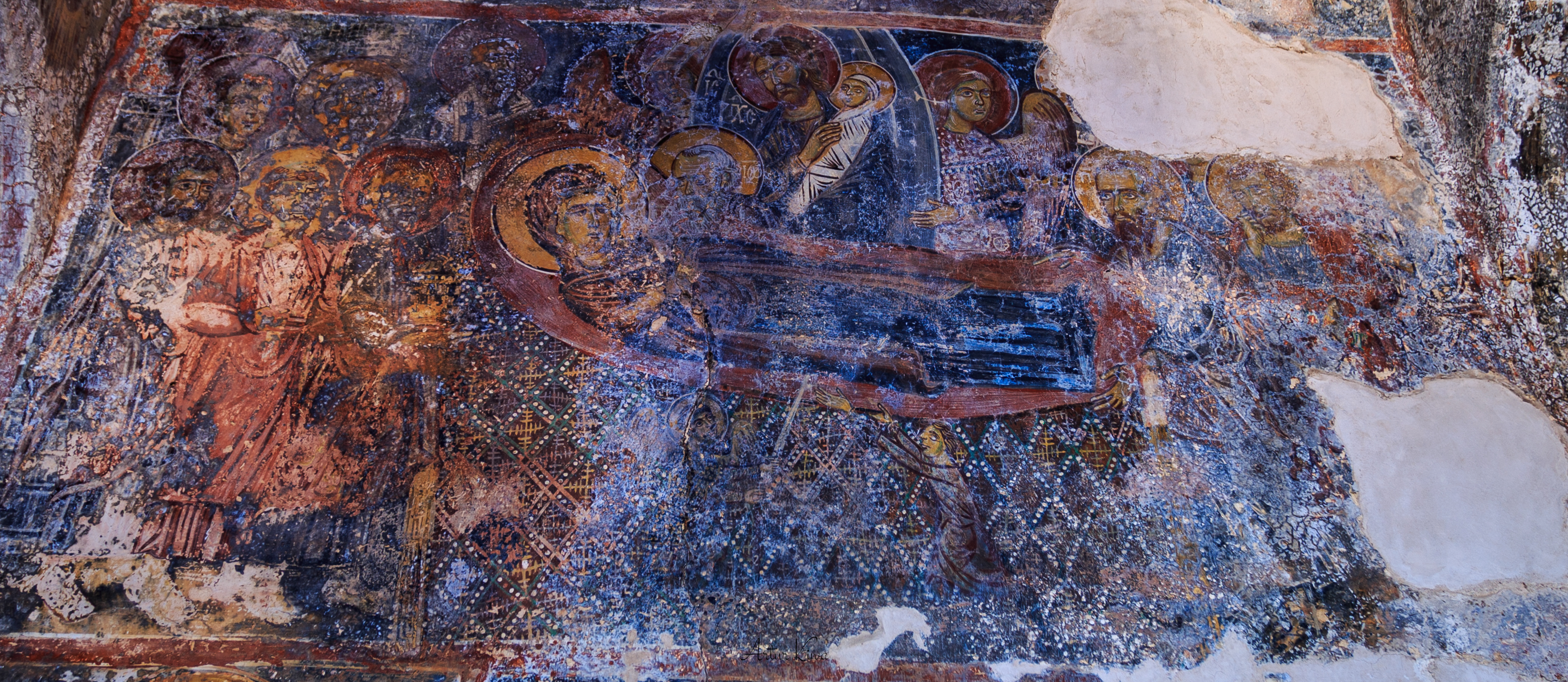
Everyone today is talking about Dekapentavgoustos, the feast known in the Orthodox tradition as the Dormition of the Mother of God. So let me add my own trumpet blast to the choir – iconographic, as usual.
A reward to anyone who can find in the canonical Scriptures a detailed account of Mary’s final days. The Gospels are silent. The last narrative encounter with Mary is at the foot of the Cross. Yes, yes – the Acts of the Apostles mention her again, but that is no longer “gospel” in the strict sense. So where does the official feast come from? The short answer: from a very ancient Jerusalem tradition. The earliest liturgical evidence dates to around the 5th century. Specifically, in the Jerusalem Lectionary, 15 August appears as the “Commemoration of Mary, Mother of Christ.”
Byzantine tradition (following the late antique historian Nikephoros Kallistou) attributes to Emperor Maurice the decree ordering that the Dormition be celebrated on 15 August throughout the empire. That explains why the date from Jerusalem became universal in the East. The testimony is indirect – the actual edict has not survived – but it reflects a process of liturgical unification. The feast entered Rome under Pope Sergius I (687–701), who, according to the Liber Pontificalis, instituted processions for four Marian feasts, including the Dormitio on 15 August. By the 8th century, Roman books already use the term Assumptio.
In the East we have Koimesis (the Dormition), preceded by a strict fast from 1 to 14 August; in the West – the Assumption. The theology runs in parallel: both celebrate Mary’s passage into glory (terminology differs, content is shared).
The feast grew out of tradition; the Gospels offer no narrative. Which means, of course, that iconographers had an open field. No canonical account? No problem. The apocryphal literature and the liturgical tradition provide plenty.
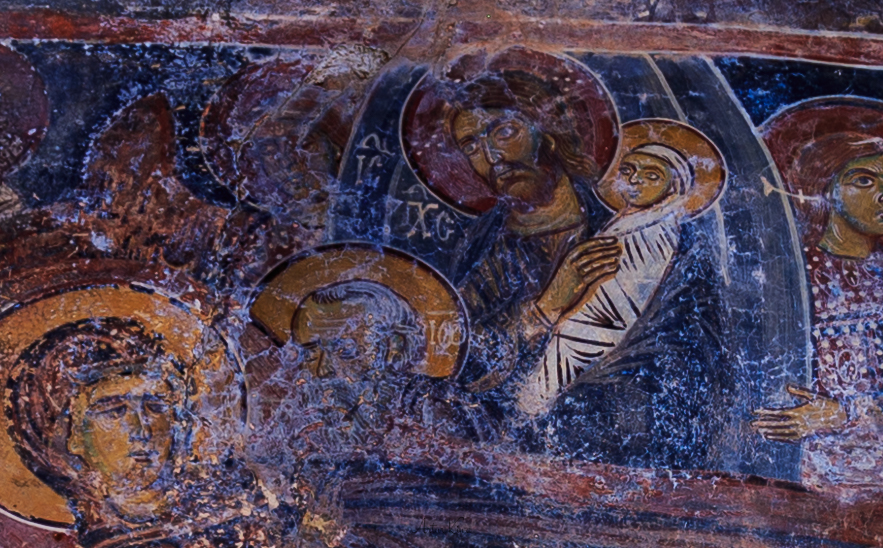
The standard composition is remarkably stable. At the center lies Mary on a bier. Above her stands Christ in a mandorla, holding her soul in the form of a small swaddled child. Around them the apostles, usually with Peter and Paul at the forefront. This scheme appears from the early Middle Ages and never really changes.
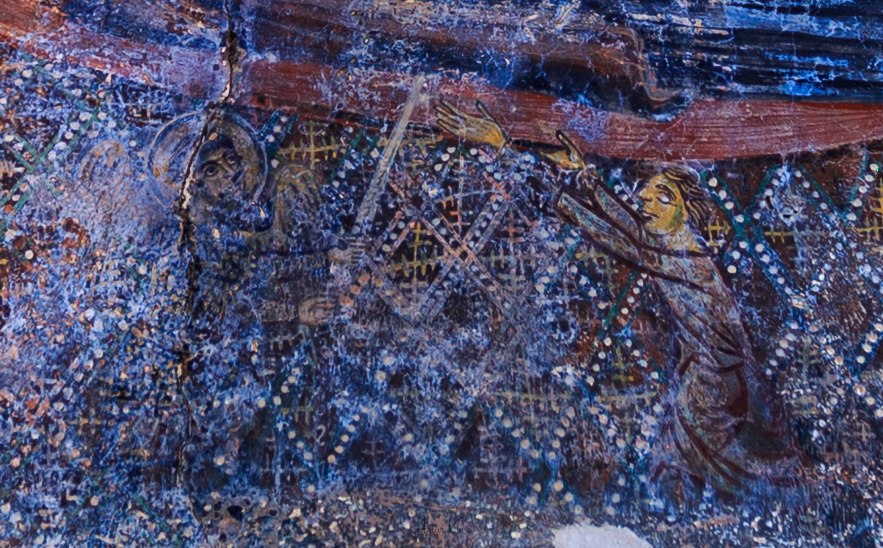
In post-Byzantine fresco cycles we often encounter the apocryphal motif of the priest Jephonias whose hands are cut off by an angel. In both Greek and Latin versions of the Dormitio/Transitus Mariae, Jephonias (sometimes simply “the Jew”) tries during the procession to overturn the bier of the Mother of God; an “angel with a flaming sword” severs his hands, which remain attached to the bier. After he repents, the hands are restored – in some versions at the word of Saint Peter.
This dramatic episode is usually read in parallel with Old Testament images of the Ark of the Covenant. In homilies and hymnography Mary is often called the “Living Ark,” and Jephonias is compared to Uzzah (2 Sam 6), who dies for touching the Ark unworthily, and to the fallen hands of Dagon (1 Sam 5).
And finally – the practical point.
If you find yourself on Crete on the 15th of August, climb at least one mountain. Look from the ridge out toward the sea. Then look again at the icon: the Mother on the bier, the Son holding her “soul-child.” No footnotes, no geography: one scene that says more than a whole lecture. The rest is only wind, bell, and chant: “Υπεραγία Θεοτόκε, σώσον ἡμάς.”