Crete keeps shaking — and not just recently.
The birth of a new island on an old map.
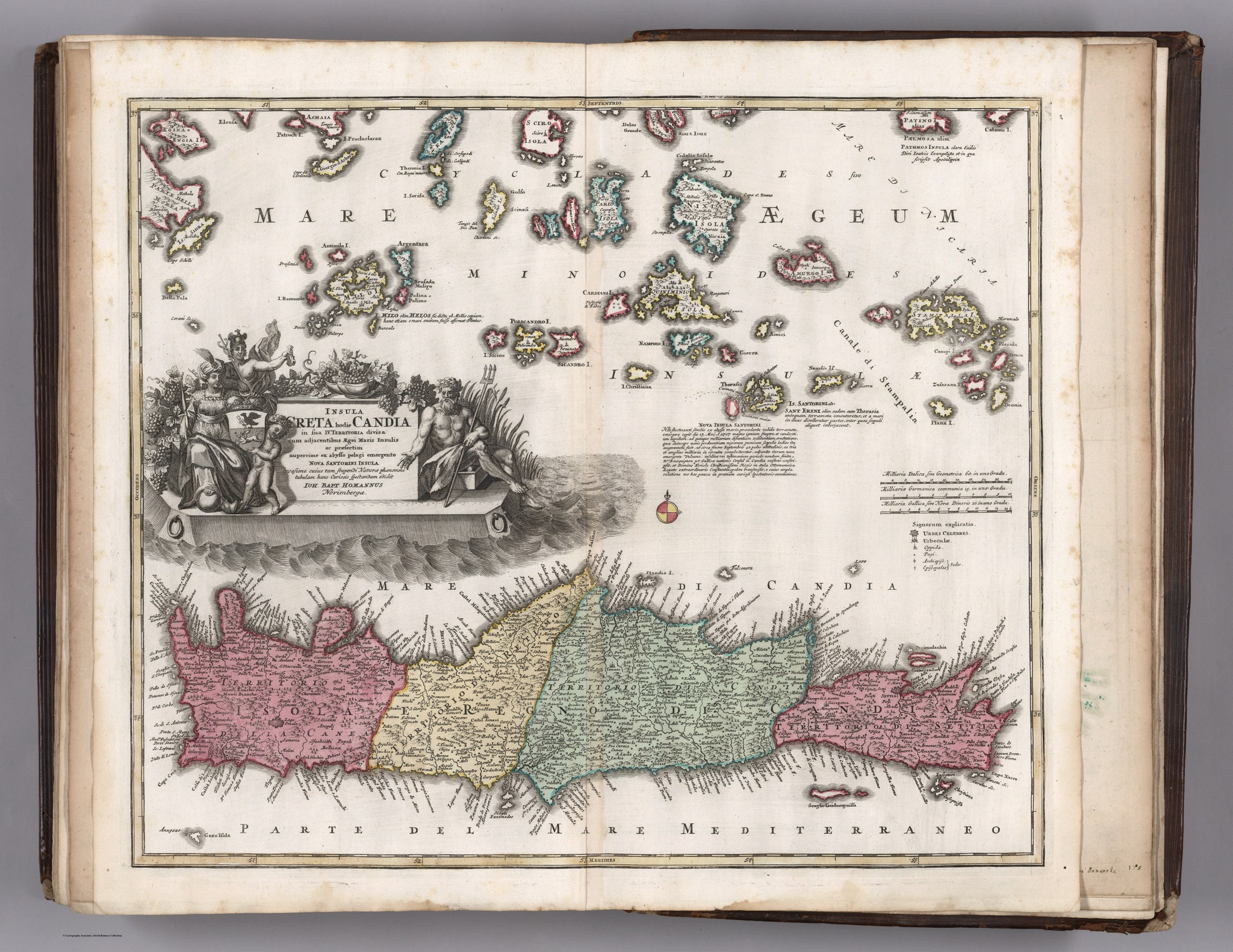
Crete shakes, thankfully not from cold but from seismic stubbornness, so here’s something in the spirit of tremors, with a historical twist.
On 23 May 1707, the calm waters of the Santorini caldera were torn apart by a thunderous roar. From the depths of the Aegean Sea, a new island began to rise—spitting fire, glowing stones, smoke and steam. Within months, a fresh patch of land had formed, growing day by day. By September, it stood over 12 meters high and more than 3 miles in circumference. Modern geologists confirm: this was one of the crucial phases in the birth of Nea Kameni, the fiery island at the heart of Santorini’s caldera.
This extraordinary event was recorded almost immediately across Europe. The German cartographer Johann Baptist Homann described it on his map of Crete (then known as Candia), published in Nuremberg. He added a dedicated cartouche about the “New Santorini Island,” relying on a report by the French consul in Candia, who sent his observations to Constantinople. To Europeans of the time, this was a marvel of nature—dangerous, spectacular and very real, a moment when a new world seemed to emerge before their eyes.
For the curious, here is the full translation of the Latin inscriptions from Homann’s map:
Main title cartouche:
The Island of Crete, today called Candia,
divided into four territories,
together with the adjacent islands of the Aegean Sea,
and especially
the New Santorini Island,
lately rising from the depths of the sea,
on the occasion of this most astonishing natural event
this plate has been published
for the benefit of curious observers
by Johann Baptist Homann
in Nuremberg
Cartouche about Santorini:
New Santorini Island
This island, trembling like the sea itself, rose from the abyss after a violent earthquake
on the 23rd day of May, in the year 1707,
accompanied by great noise, fire and glowing stones.
At a distance of about five miles there were eruptions, explosions and other phenomena,
from which a new rocky mass began to emerge—black and reddish—
growing day by day.
By the end of September it reached a height of 40 feet
and exceeded 3 miles in circumference,
formed from the new earth expelled by the volcano.
A rare testimony to a process that has not yet come to an end.
Monsieur Bourguignon, the French consul in Candia,
sent his account to Constantinople through a special messenger
of the King of France to the Sublime Porte.
On the basis of this detailed report we offer these notes
for the benefit of curious spectators.
Notes:
- Johann Baptist Homann (1664–1724) – German cartographer and geographer, member of the Imperial Academy of Sciences in Vienna. Founder of a major publishing house in Nuremberg known for high-quality artistic and scientific maps widely circulated in Europe in the 18th century.
- Monsieur Bourguignon – described by Homann as the French consul in Candia (Heraklion). His full name is not given, but he was the source of the eyewitness report of the 1707 volcanic activity.
- Monsieur Teriolo – likely François de Tériol, extraordinary envoy of Louis XIV to the Ottoman court in Constantinople. He transmitted the consul’s report to the political center of the time.
Map:
David Rumsey Map Collection, David Rumsey Map Center, Stanford Libraries