Seraphim and Cherubim in Cretan Iconography
Heavenly beings in the churches of Crete and why their presence is so rare and exceptional.
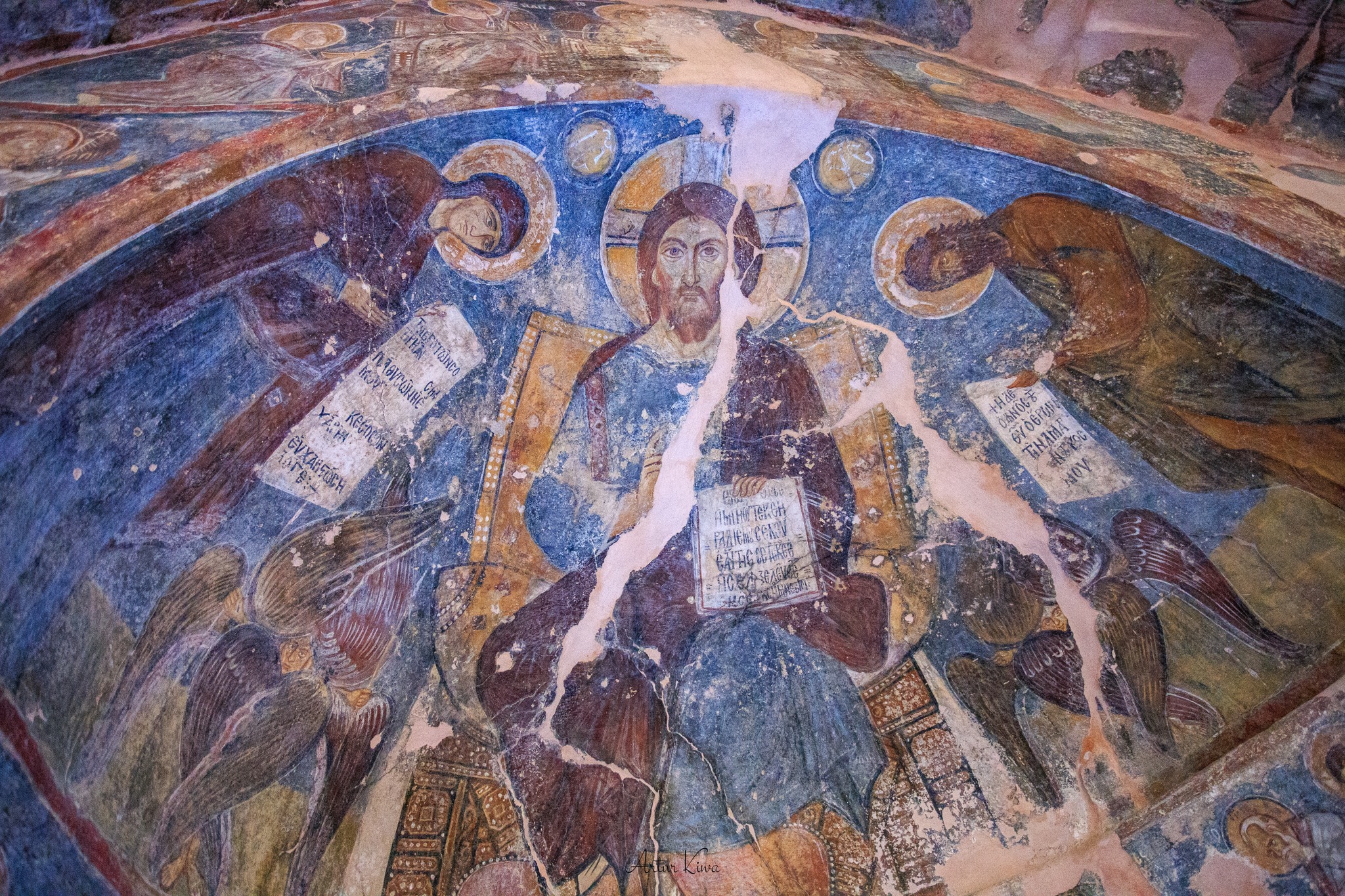
Among the more than eight hundred Cretan churches dating to the Byzantine and Venetian periods, depictions of the highest celestial beings – Seraphim and Cherubim – are surprisingly rare. This is not a coincidence but the result of theological, spatial, and liturgical priorities that shaped the visual language of rural Crete. Most village churches were single-aisled, with a simple apse and very limited wall space. Their iconographic programs had to focus on essentials: the Christological cycle, major feasts, prophets, and local saints. This was catechetical imagery, designed for an audience often unable to read, for whom frescoes served as a “visual Gospel.” More advanced angelology – heavenly hierarchies, theophanies, throne imagery – appears primarily in larger urban churches or those funded by prominent families. In small Cretan temples there was neither space nor liturgical need for it.
Political change after 1204 brought a new dynamic to the island. Venice had purchased Crete from Boniface of Montferrat, but real control was established only around 1211–1212. Although the takeover was not a classical military conquest, the collision between Latin ecclesiastical administration and local Orthodoxy created deep tensions. The new rulers promoted Latin clergy, limited the authority of Orthodox bishops, and reorganized dioceses. The result was a sequence of uprisings in the thirteenth and early fourteenth centuries, where religious identity fused with political resistance. Yet the situation was never simply black-and-white: contact with Latin culture and later Italian Renaissance brought artistic impulses that helped shape the Cretan School of icon-painting and enriched the island’s cultural life, from Erophile to Erotokritos.
Within this context, depictions of Seraphim and Cherubim take on special significance. To understand their place in Cretan art, one must turn to theological tradition. Since the sixth century, the key text for Christian angelology has been De Coelesti Hierarchia, attributed to Pseudo-Dionysius the Areopagite. It establishes the nine orders of heavenly beings arranged in three triads, with Seraphim, Cherubim and Thrones forming the highest. Byzantine iconography adopted this classification as its structural foundation. On Crete it resurfaced particularly during the Palaiologan period (thirteenth–fourteenth centuries), when the island maintained closer connections with the imperial centre. Yet rural fresco programs, bound by space and function, could not fully express these hierarchical visions. Such imagery requires architectural volume – domes, drums, vaults – and a liturgical context that highlights divine majesty.
Philological detail also plays a role. The Hebrew שָׂרָף (šaraf) can mean “serpent” or “to burn, to glow.” In the Book of Numbers, God commands Moses to make a “fiery serpent” – a šeraf. The same root underlies the term seraphim. They are associated with fire, though not destructive fire: purifying fire, the fire that guards the divine realm from profanation. The Greek forms σεραφείμ and χερουβείμ preserve the Hebrew plural and are transliterated rather than translated.
It is also essential to note that Seraphim and Cherubim are not “angels” in the biblical sense. In Scripture, “angel” (Hebrew malach, Greek angelos) means “messenger” – an emissary performing a communicative function. Seraphim and Cherubim are never described with this terminology. Their role is entirely different: they are guardians of divine presence, beings that veil and protect God’s throne.
The symbolism of wings, later associated with angels in general, originally belonged only to these highest beings. In ancient Egypt the royal throne was guarded by the uraeus, a winged cobra representing divine protection. Echoes of this motif entered both Jewish and Christian imagery. Thus wings belong primarily to the highest triad: Seraphim (six-winged) and Cherubim (often four-winged or described in hybrid, zoomorphic forms). Angels – the messengers – have no wings in any biblical text.
In Isaiah, the Seraphim cover their faces and their “feet,” the latter a Hebrew euphemism for covering one’s nakedness. In practice they cover the entire body, because their function is not to overshadow God or draw attention away from Him. Thrones – another order of the highest triad – appear as static supports of the majestas Dei. Cherubim, in Byzantine liturgical art, extend their wings forward to shield the throne, bowing deeply in reverence. They are not dramatic figures; their role is theophanic and liturgical. For this reason, in Cretan painting they appear mainly in contexts of divine majesty: the Pantokrator in the dome, Deesis compositions, apse thrones – rarely, if ever, in narrative cycles.
Placing such beings in a simple rural nave would have been theologically excessive, obscure to the average worshipper, and incompatible with the pastoral function of the space. The absence of Seraphim and Cherubim in small Cretan churches does not reflect artistic ignorance. On the contrary, the island’s workshops were highly educated. Rather, their presence was reserved for settings where liturgy emphasized the sovereign presence of God and where architecture allowed for an adequate visual expression.
It is precisely within the intersection of local folk tradition, the theological rigour of Orthodoxy, and the political-religious tensions of the Venetian period that one must seek the answer to why Seraphim and Cherubim are so rare on Crete – and why they are so powerful and meaningful when they do appear.