Three Men on a Bench (To Say Nothing of the Thief)
On how Paradise was painted in Crete — and why it still matters.
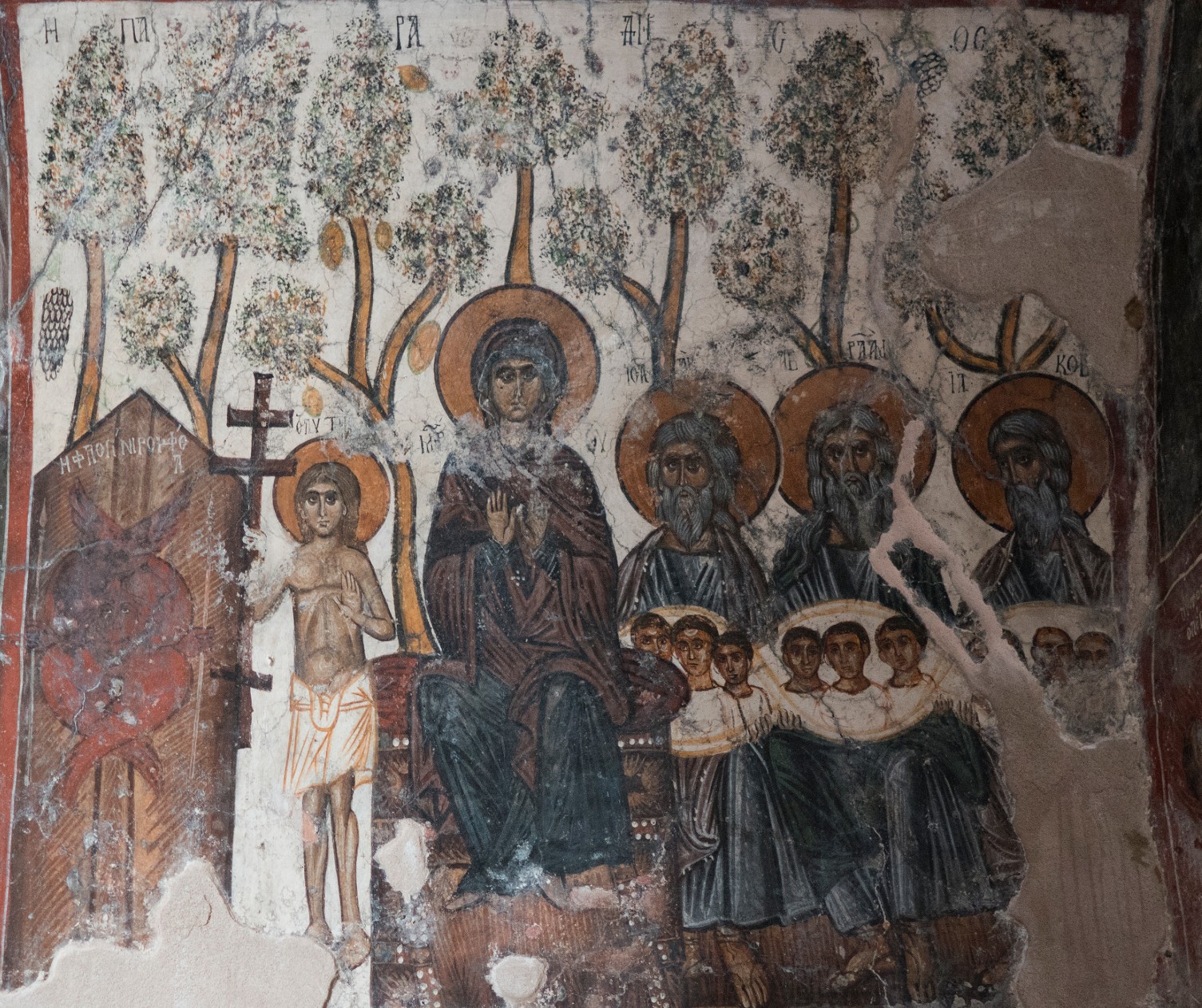
Paradise in icons always looks different from what we imagine. It is not a travel-brochure garden, not an idyllic meadow, not a heaven painted in pastels. In Cretan frescoes, Paradise is memory — the memory of a promise given to humanity before anything had yet been broken. And only when you stand before the paintings in Panagia Kera in Kritsa or in Agios Ioannis Prodromos in Deliana do you see how literally this memory has been painted. It is a space where patriarchs meet, where a guardian with a flaming sword stands, where the youthful Good Thief appears, where the Mother of God prays, and where the faces of the righteous rest within wide vessels. All of this emerges from colors that are not decoration, but theological language.
From the left side of the scene in Kritsa, the story begins with a seraph. The red of his wings is not accidental. In iconography, seraph means “the burning one,” and it is precisely this spiritual, otherworldly red that recalls the verse from Genesis: “He placed at the east of the garden of Eden a flaming sword that turned every way” (Gen 3:24). The fresco names it explicitly: “Η ΦΛΟΓΙΝΗ ΡΟΜΦΕΑ.” Yet this sword no longer guards Paradise against humanity. It stands rather as a witness to a former closure — a reminder that Paradise existed and still exists, but that the path to it was inaccessible for a long time. Only the Christian narrative of the Incarnation reopened that gate.
This is where the entire scene leads. When your gaze moves to the right, you enter the heart of the composition: three patriarchs seated on a simple bench. Abraham, Isaac, and Jacob — not gilded, not excessively idealized, but calm, clothed in browns, greys, and muted greens. The fresco does not turn them into heroes, but into people who have walked a long road and now have a task: to receive those who were “carried to the bosom of Abraham” (Luke 16:22).
In icons, the “bosom” is not a metaphor. The patriarchs hold wide, bowl-like garments, and within them are young, harmonious faces of the righteous. In iconography, the soul is never a mist or a shadow. The soul has a youthful face, because youth signifies renewal — a return to original beauty. Abraham holds the largest vessel, as if he had the greatest space to receive those who waited for him. Isaac, in the center, paused mid-gesture, seems to recall the promise given to his own life. Jacob looks more toward the left side of the fresco, as if sensing that what happens there is the key to the entire story.
Because that is where the thief stands.
The first to enter Paradise after the death of Christ. The Good Thief — known in Western tradition as Dismas, and in Eastern tradition as Rakh (Ράχ). The name “Rakh” is a fascinating case: it likely emerged from an error. Scribes copying Greek manuscripts easily confused abbreviations, ligatures, marginal notes. Somewhere in this noise of letters, a name was born — the name by which the Eastern tradition now knows the holy thief. Not inherited from a firm tradition, but produced by a mistake. And sometimes, in the history of iconography, error proves fruitful.
The thief — Dismas or Rakh, choose your version — stands beside the guardian of Paradise, but already on the right side. He is young, because that is how a redeemed soul is shown. In his hand he holds a cross — the symbol of his own salvation. His figure is a visual answer to the words spoken by Jesus in the Gospel of Luke: “Today you will be with me in Paradise” (Luke 23:43). The fresco takes these words literally. The thief is already here. He has already crossed over. He already belongs to the world of the righteous.
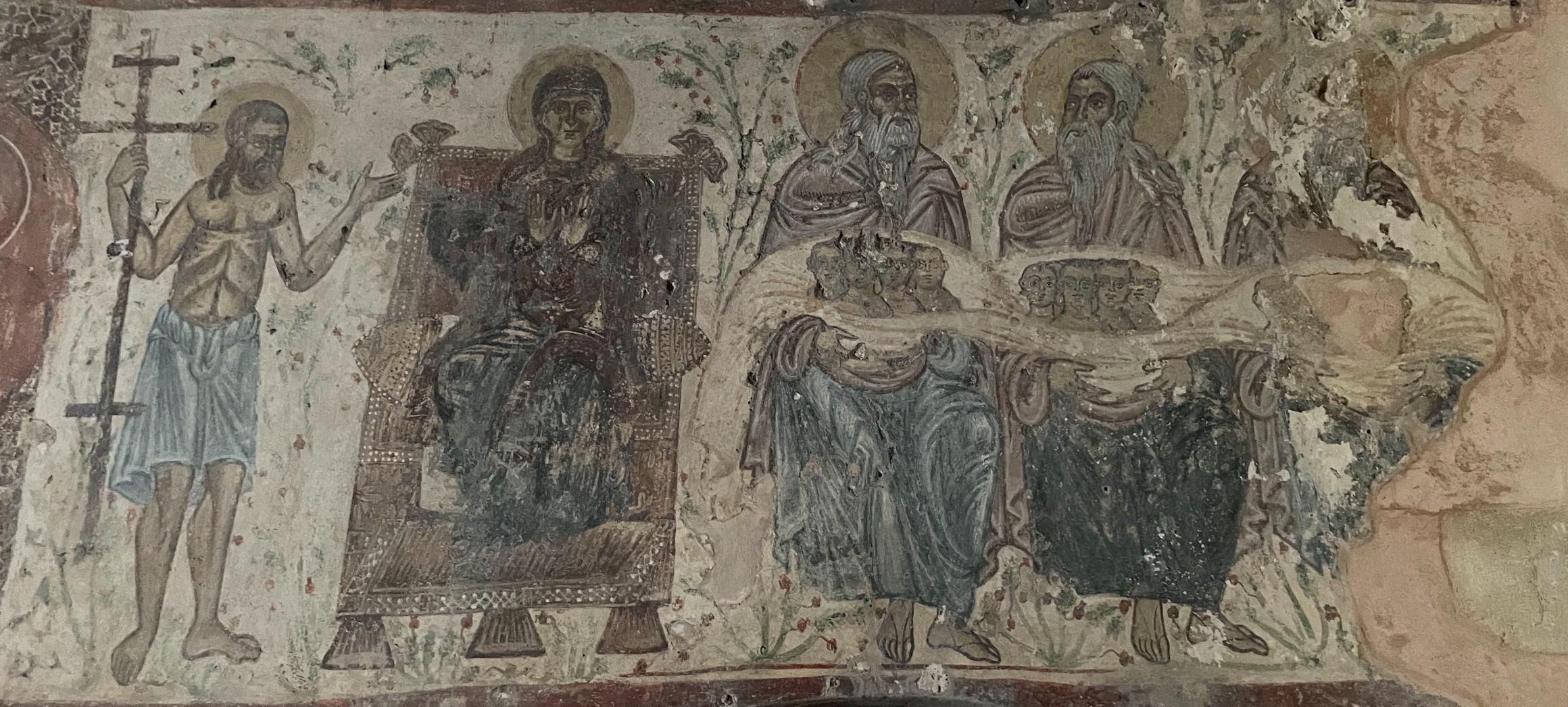
Deliana paints the same scene differently — more austere, with a stronger emphasis on asceticism. There, the thief appears emaciated, his body marked by suffering, and the patriarchs seem to hold their vessels closer together, as if the entire Paradise were more condensed, more silent. This is a stylistic difference, not a theological one — like a story told in a different dialect of the same truth.
In both frescoes, the Mother of God plays a crucial role. She does not stand at the center, yet without her the scene would be incomplete. Her gesture of prayer is the theological key to the image: it is through her that the Incarnation became possible. And if the Incarnation, then the reopening of Paradise. She stands on the boundary between worlds — the old, closed garden guarded by a flaming sword, and the new reality in which Paradise is once again accessible.
In the end, what remains are the trees — the quiet witnesses of the entire composition. In Kritsa and Deliana they appear similar: light, delicate, almost childlike. These are not botanical trees; they do not grow to provide realistic scenery. They are meant to recall the “tree of life” (Gen 2:9), the one that always stood at the center of the garden and that in icons continues to remind us that the original plan for humanity has not been erased.
And so both frescoes say the same thing: Paradise has not disappeared. It was closed, but not lost. Now it stands open. The patriarchs are not figures of the past, but guardians of hope. The Good Thief — a man whose entire life may have been a catastrophe — is the first to take that hope literally. And the seraph with the sword no longer bars the way, but tells the story of how closure gave way to entrance.
Crete knows how to do this. How to turn a simple fresco into a reminder that Christmas Eve — the day when everything began — is not merely a commemoration of a birth in Bethlehem. It is the day when Paradise, the real one, the one described in Genesis, begins to become real again. The frescoes of Kritsa and Deliana show that moment of absolute change: the beginning of humanity’s return to the place it once left and to which — according to this bold, evangelical logic — it is meant to return.