Pantokrator: A Presence Impossible to Ignore
In Cretan churches, the image of the Pantokrator does not tell a story – it establishes a relationship in which the human being ceases to be the centre, and God reclaims His place above the world.
The Pantokrator was not born as a decorative element, nor as a convenient way to fill a dome. In the form we know today — frontal, immovable, suspended above the human being — two powerful traditions meet: the Jewish vision of God as the One who “rules over all nations,” and the Greco-Roman idea of a cosmic order in which everything has its place. As Christianity matured in the East, these two streams fused into a single intuition: that the world is far too vast and far too fragile for the human being to pretend he stands at its centre. Byzantium resolved this truth architecturally — by placing God in the dome. Not on the wall, which you can walk past. Not in the sanctuary, where “something happens.” But above your head, where heaven begins.
In this way the Pantokrator became not so much an image as a presence. His frontality has nothing to do with artistic style or aesthetic preference; it is the consequence of a way of thinking about God as the One who “stands opposite,” who sees the human being as he truly is. When you look at the Pantokrator, you are not viewing a scene from the life of Jesus. You are looking at someone who is looking at you. And this gaze does not arise from emotion, but from function. The Eastern Christian did not enter the church for comfort or for a “story.” He came to stand before a God who is greater than the world.
This differs sharply from the Western imagination, which in the Middle Ages propelled art toward narrative: nativity, crucifixion, miracles, parables, dramas, scenes of daily life. The West told the story of a God who comes close, who becomes human, who shares emotions with humankind. The East fed on a different experience — the liturgical one — in which God is light, glory, Judge, Lord of the cosmos. He is not the “friend of man”; He is man’s measure. He is not the hero of a story; He is the One before whom the human being falls silent.
Hence the difference in representation: in the West Christ descends toward the human being; in the East the human being enters the church to step beneath the gaze of God. The Pantokrator does not explain, does not illustrate; the Pantokrator establishes a relationship. The only possible relationship between the One who created the world and the one who lives within it. This is why Cretan churches — even the most modest — possess an intensity impossible to compare to anything else. Where the vault is low and the light enters through a single narrow window, the Pantokrator appears almost primordial — like a truth that requires no words.
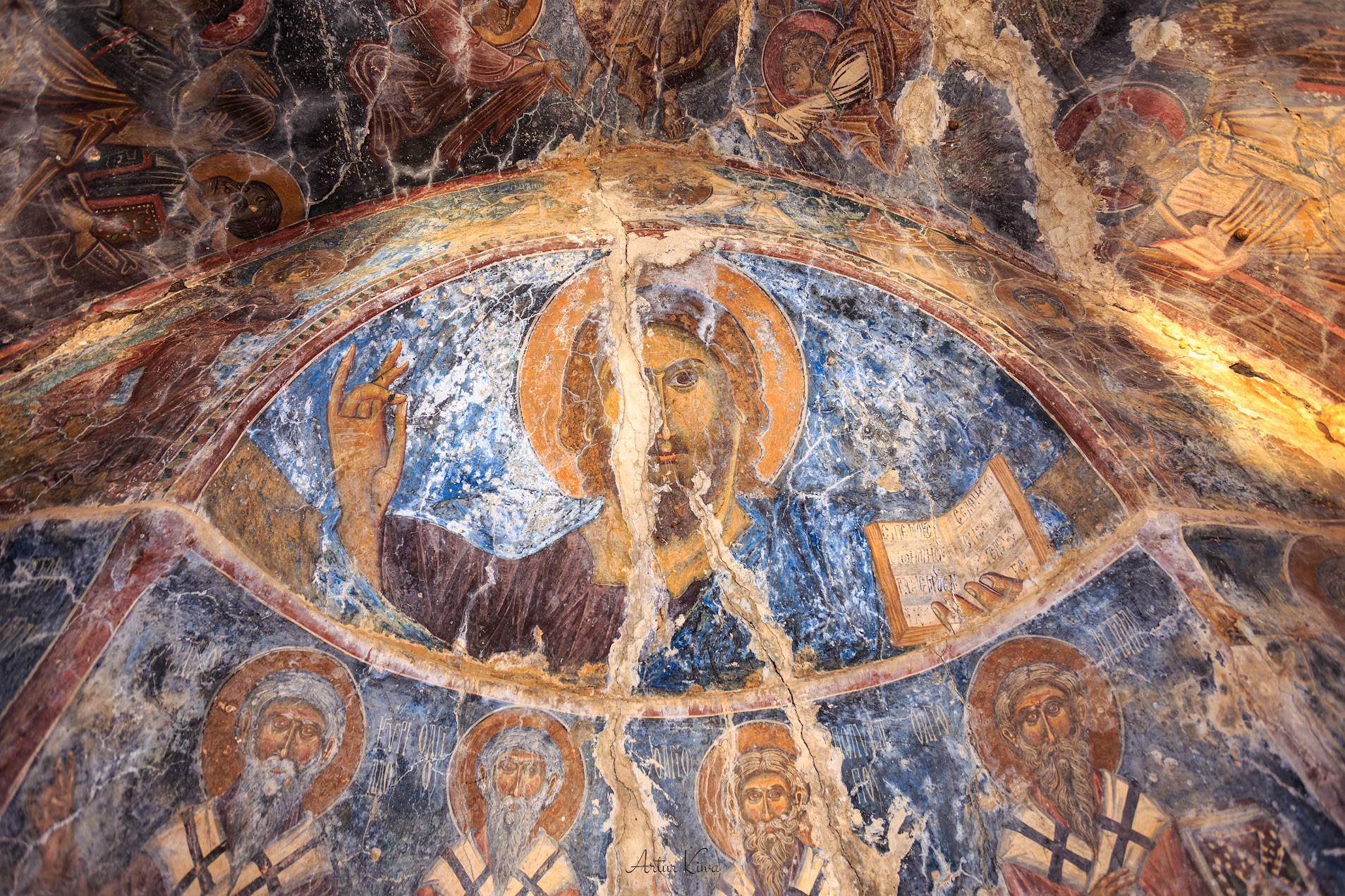
In the church of Michael the Archangel in Vathi, the face of Christ — executed by the hand of Pagomenos — is almost a textbook answer to the question of why the East places God in the dome. There is a stillness that does not arise from lack of dynamism but from certainty. The whole composition feels like a held breath: the broad nimbus, the open book, the calm gesture of blessing, and the gaze you cannot escape. There is no narrative. There is presence. And presence of the kind that draws silence out of the human being.
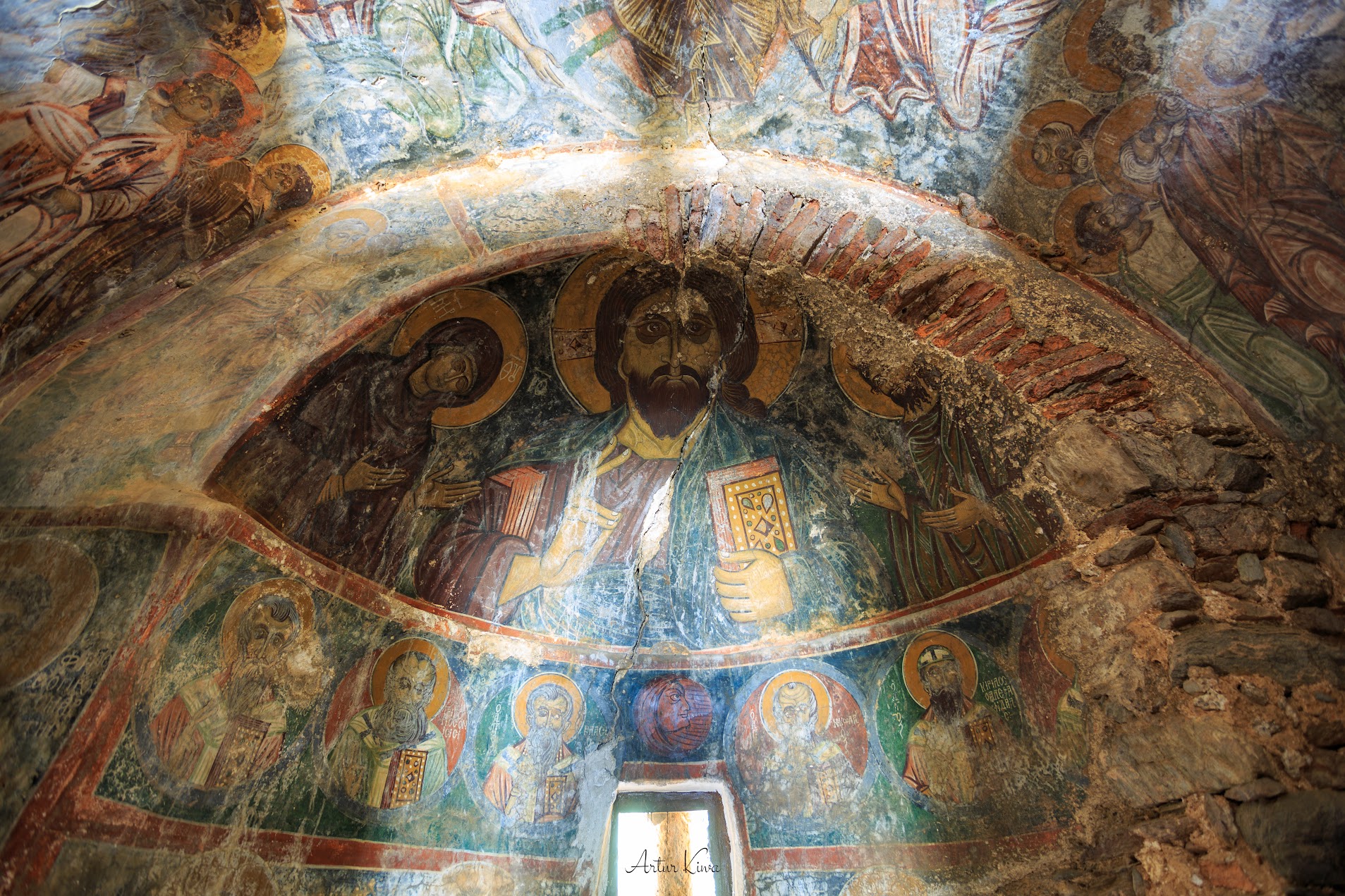
In Trachiniakos the Pantokrator is more earthy, darker, as if tied to the harsh landscape around Kandanos. The plaster is cracked, the pigment heavier, and the face of Christ has something of a man who knows heat and dust. And yet the concept is the same: a God who stands above the world but not outside reality. The face is not lofty — it is unyielding. Byzantium understood that true authority requires neither force nor dramatic gesture. It only needs to endure.
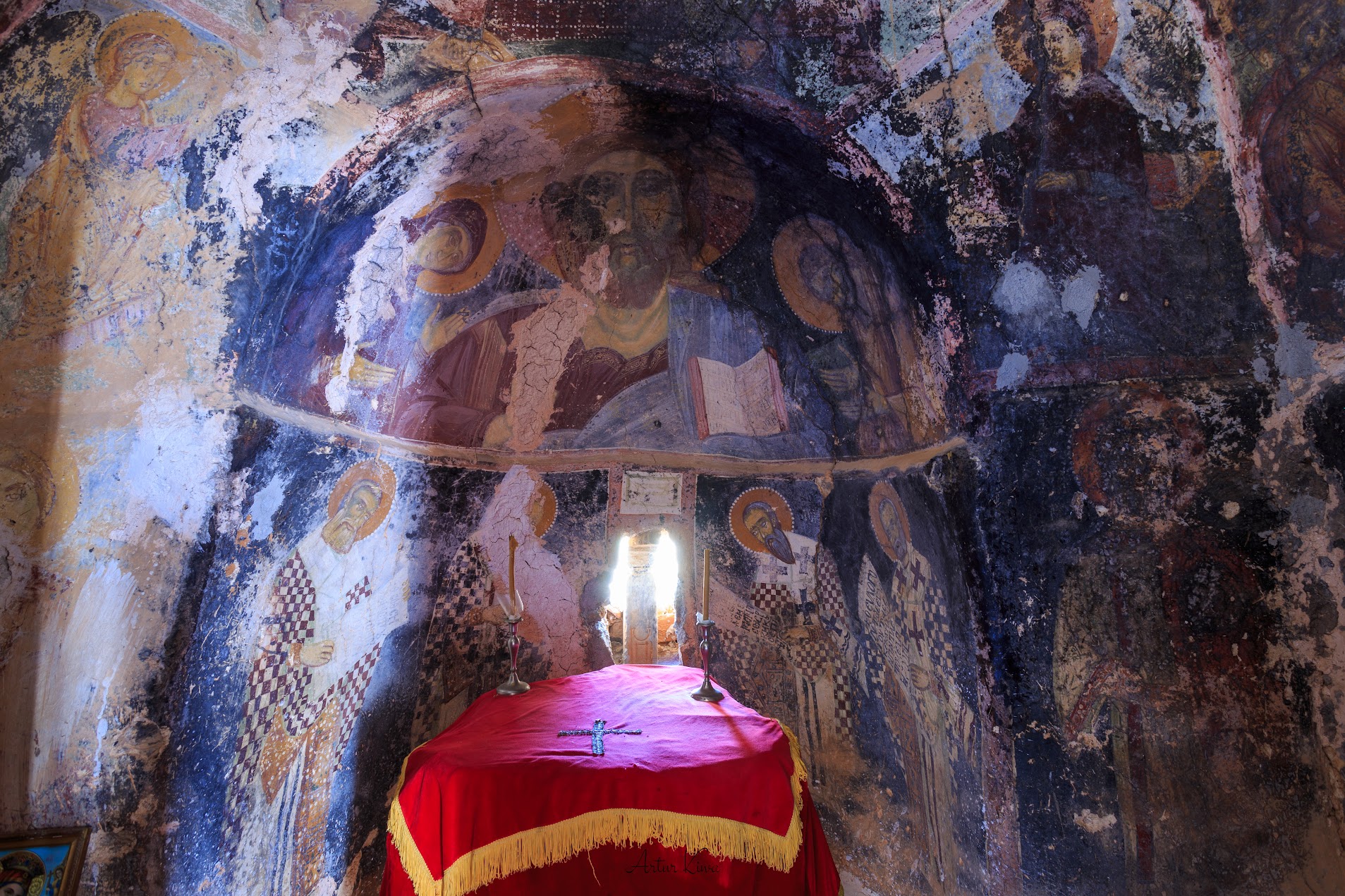
In Aradena the Pantokrator possesses a kind of fullness. He is brighter, calmer, more ordered — not because he is mild, but because he is clearly integrated into the rhythm of the entire apse. The light entering from the small window emphasises the delicate lines of face and halo, as if the fresco does not simply dominate the space but grows organically out of it. There is no severity here; there is coherence. An idea that remains because it is true, not because it has pigment.
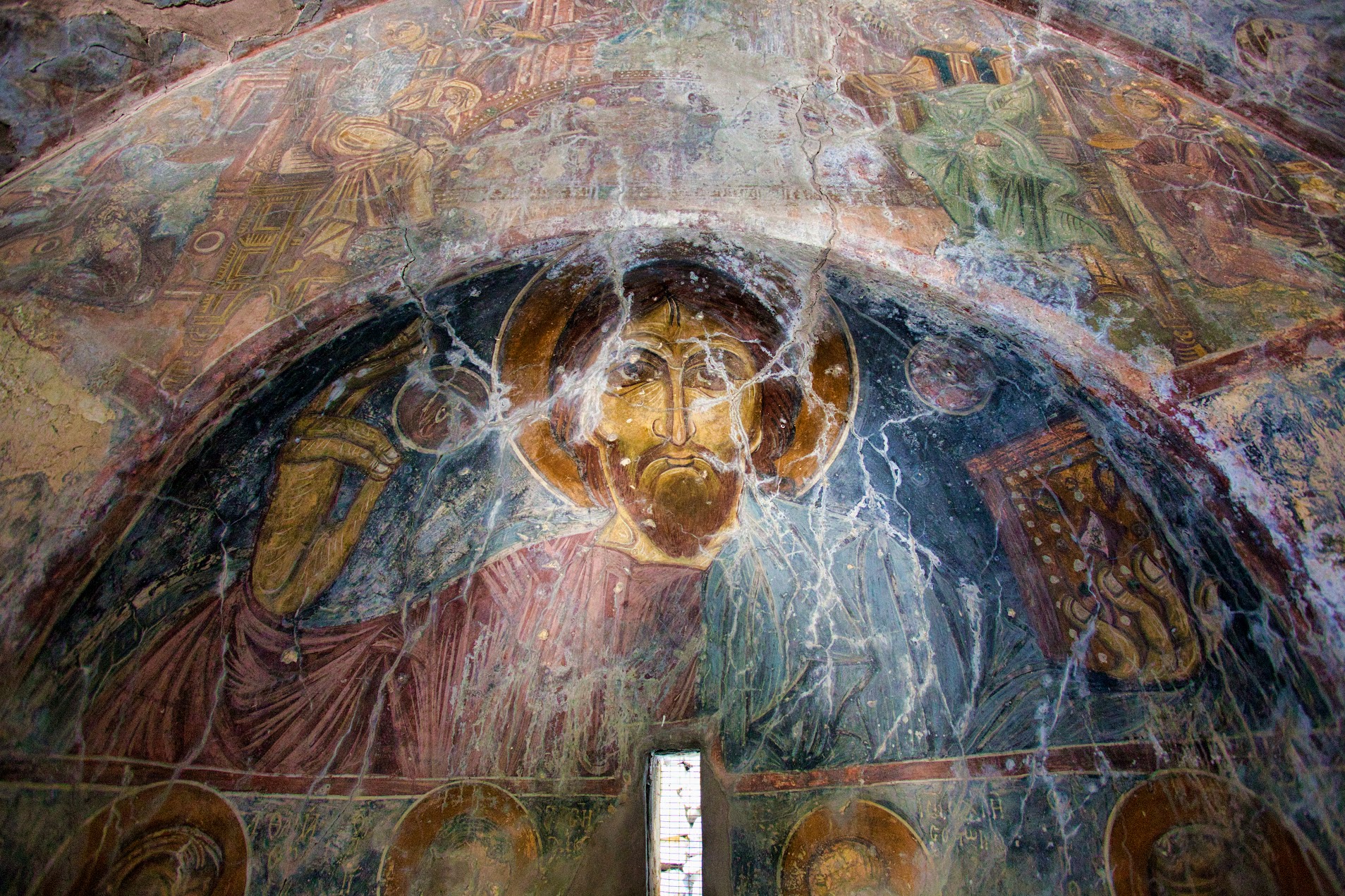
In Anisaraki the face of the Pantokrator survives only as a trace — a shadow of light, the outline of eyes almost gone but not entirely vanished. And this is precisely why it strikes the viewer most deeply. This Christ is like an echo of the original conception: even when the image is destroyed, the idea it carried remains untouched. The human sees less; God still sees. And that, paradoxically, is the most moving of all.
Four churches, four hands, four degrees of decay — and yet one concept. One theology. One understanding of who God is: not a hero in a narrative, not a figure in a story, but the fixed point that stands at the beginning and end of all things. This is why, when you leave such a church, you feel you have seen something that was not an image. The Pantokrator is not a scene. The Pantokrator is the answer to the question humanity has carried forever: who looks first?