Panagia Church in Agios Ioannis (Aradena)
An exceptional church in an exceptional place.
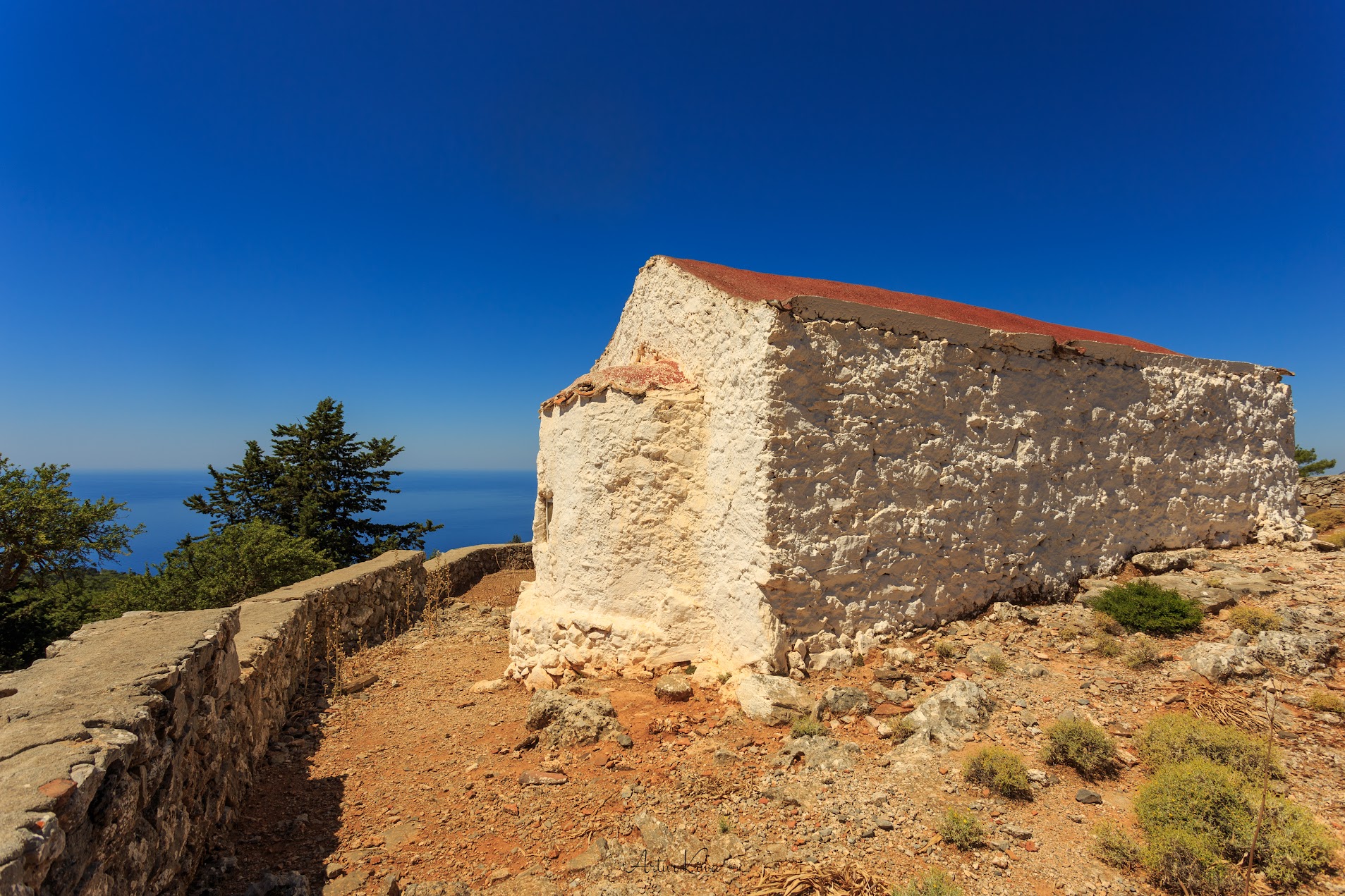
To see this church, one has to travel to what feels like the end of the world in Crete. We pass the famous bridge in Aradena and continue for about five more kilometers to the village of Agios Ioannis. This is where the road ends – it is not possible to go any further by car.
The church itself is located slightly off the main route, on a gentle rise, about a 10–15 minute walk along a rocky path from the main road. Along the way, we pass the usually closed church of Agios Ioannis and continue onward. After a short while, a small white church appears on the hill – the destination of our walk.
Do not be misled by its modest exterior. It does not make a striking impression, that is true. A simple, single-nave, vaulted structure, whitewashed with lime, with two massive buttresses at the entrance. The entrance is on the southern side. The surroundings, however, are beautiful, and the view from the hill is genuinely impressive. A typical Cretan postcard: the sea, olive trees, citrus groves, and the furious chorus of cicadas. What you are about to see inside more than compensates for the effort of getting there.
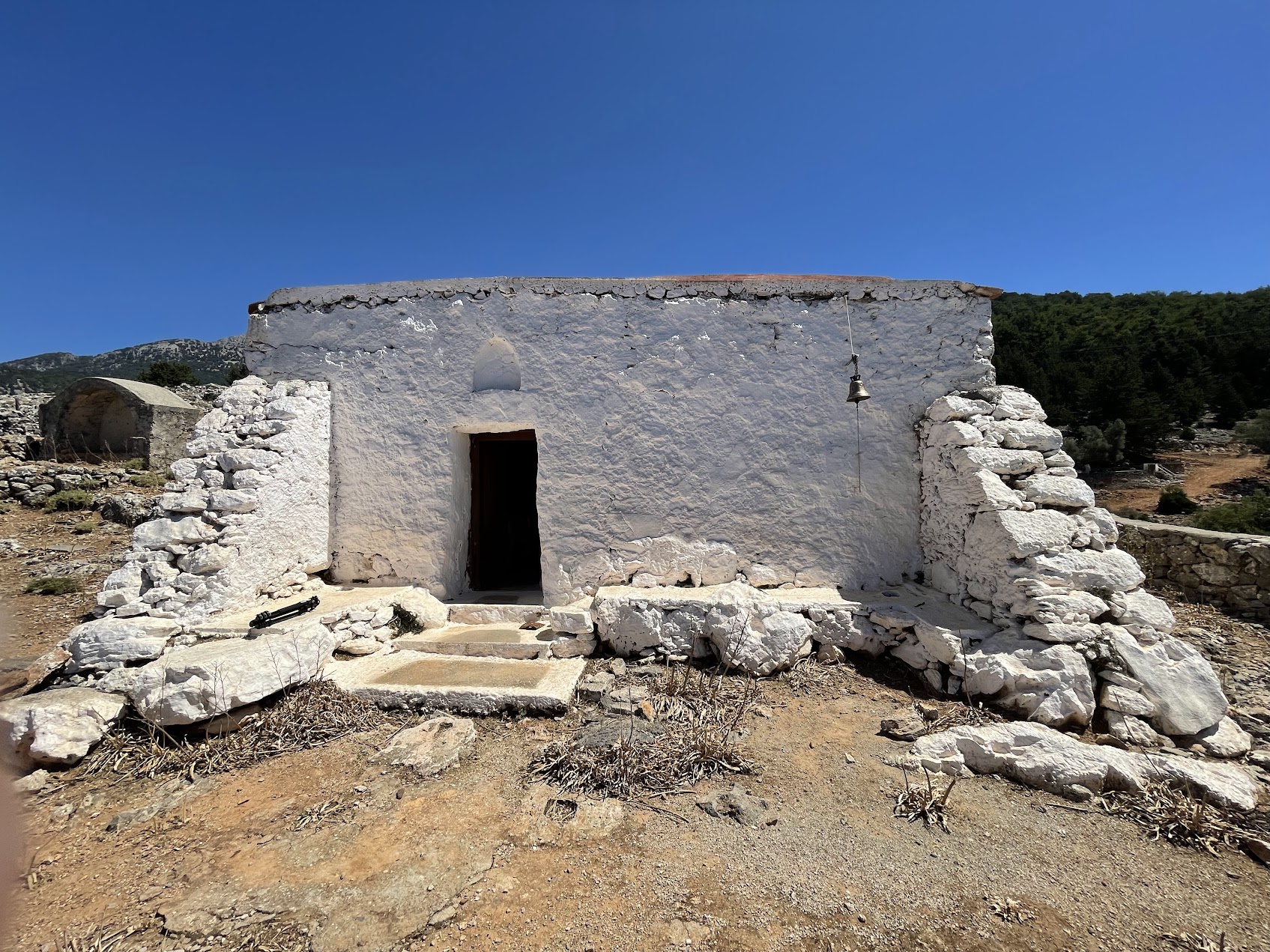
The church is exceptional. It may not look impressive, but that is not what we expect from Cretan churches. Their magic lies not in size, but in location and in the history they carry within. This small church captivated me precisely because of its setting, its surroundings, and the sense of calm that emanates from it all. It is Sfakia in a concentrated form. This impression is difficult to describe – it has to be experienced.
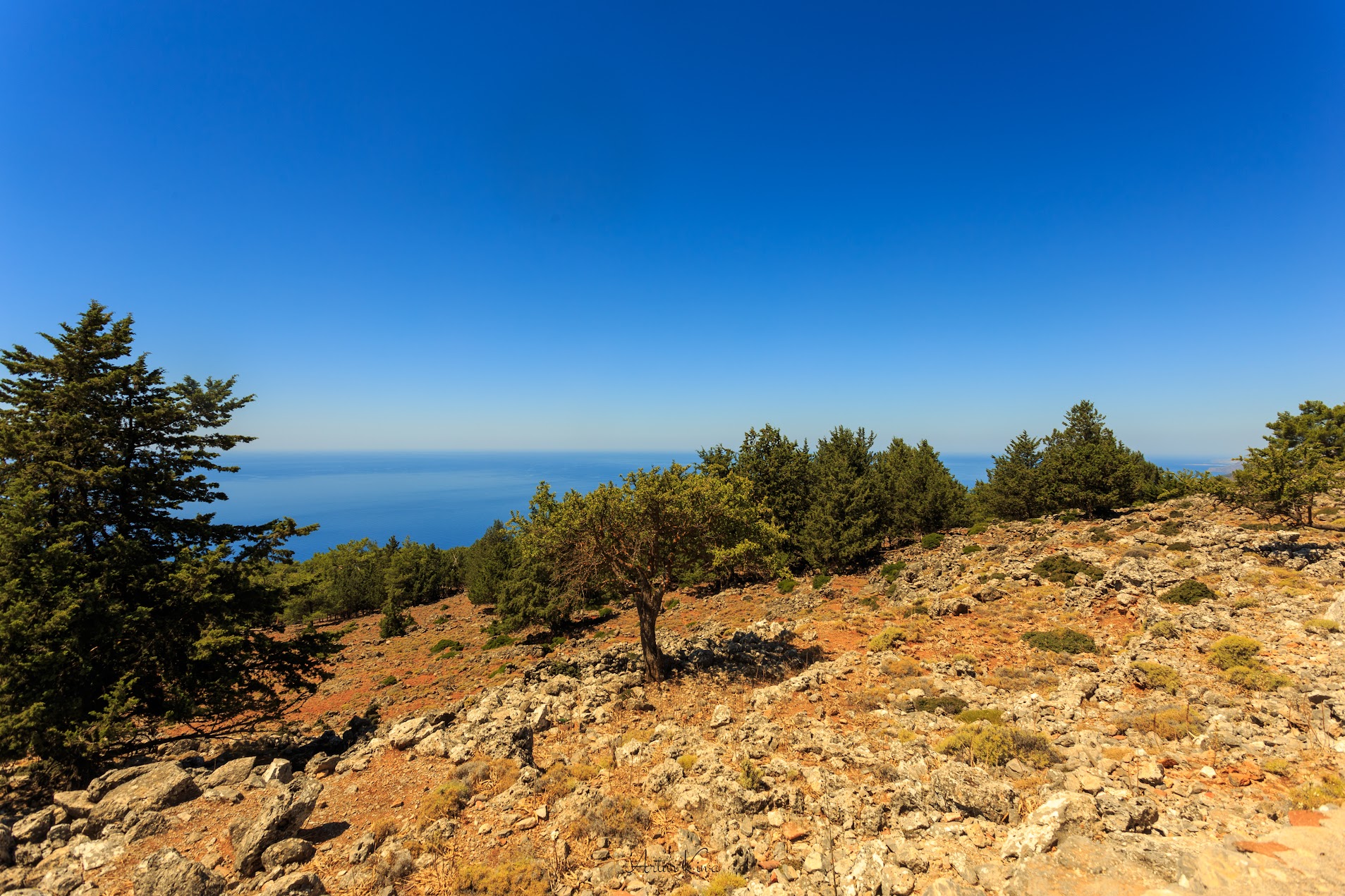
It is not known exactly when the church was built. I have not found any unambiguous construction date in the scholarly literature. Most likely, it was erected long before the painted decoration was executed, which is dated to the period between the 14th and 15th centuries. We also do not know the name of the painter, and the frescoes themselves have been heavily worn by time. Despite this, they still make a powerful impression. For me, the work of this folk painter evokes associations with the art of Nikifor Krynicki – a certain vein of primitivism, combined with expressive force, makes these paintings distinctive.
Surprisingly, four typical iconographic cycles were accommodated within such a small church. The most important of them, the Christological cycle, unfolds in the arches of the church. Here we find representations of the Crucifixion, the Deposition from the Cross, the Resurrection or the Ascension, the Baptism, and the Transfiguration.
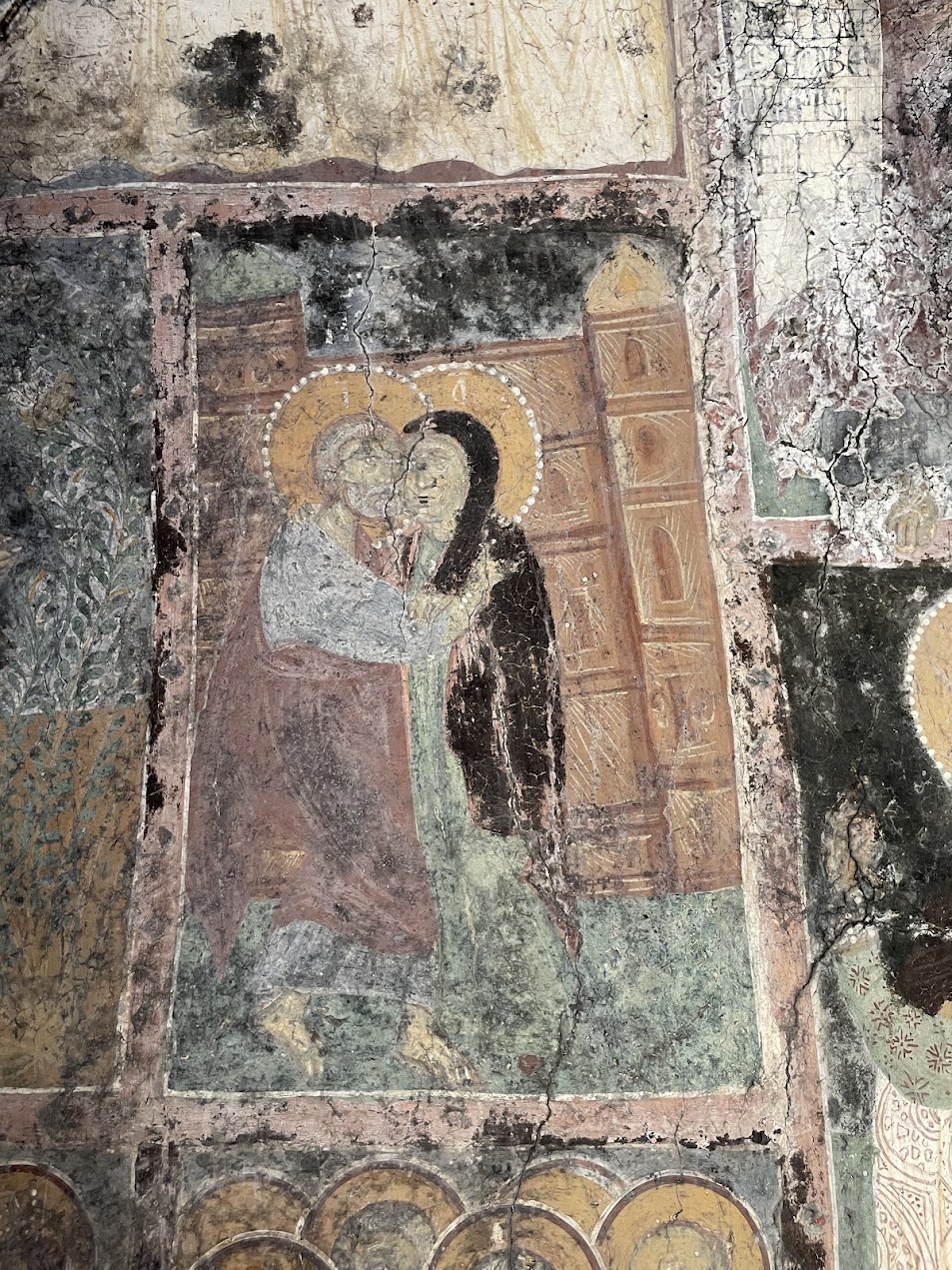
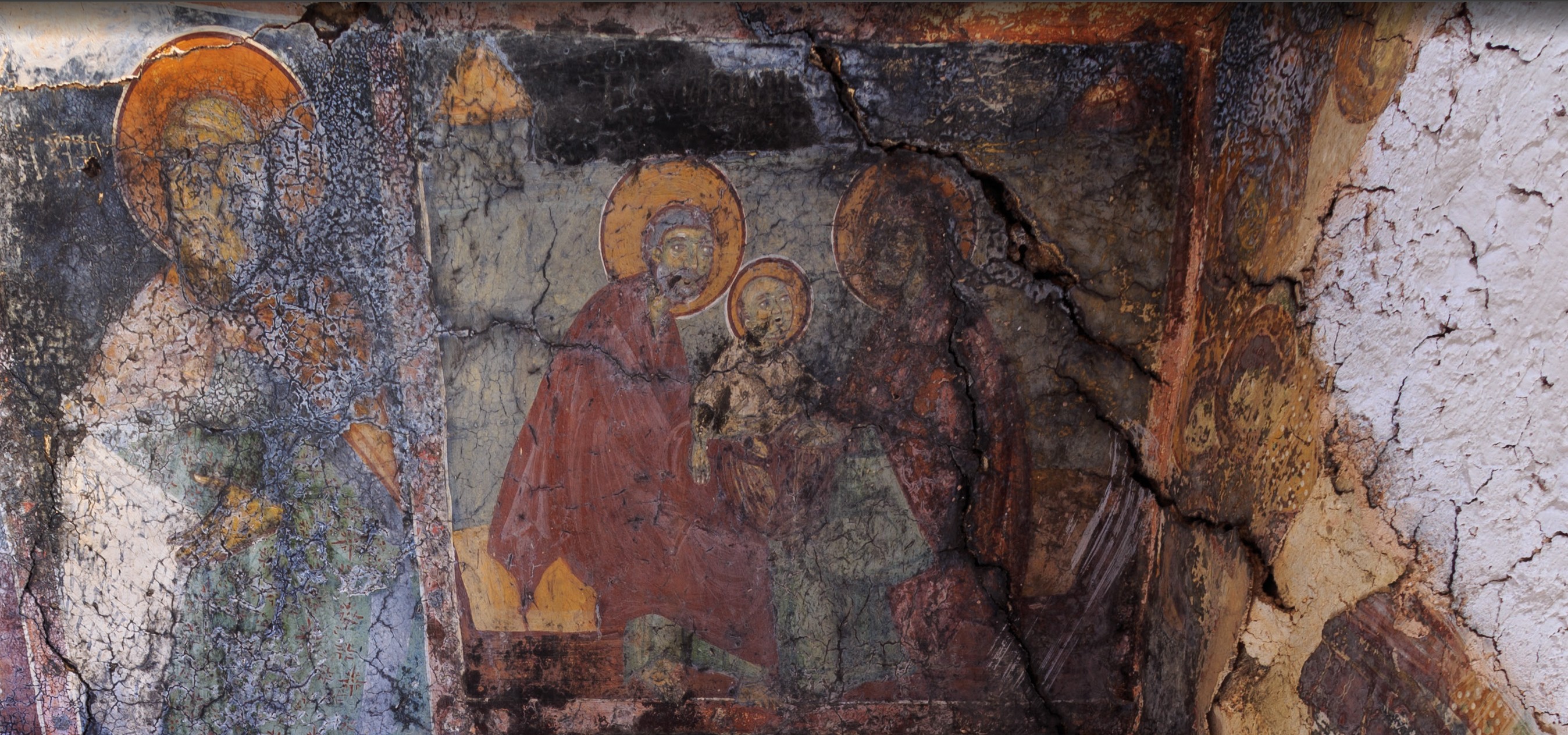
The second cycle, the Marian cycle (of the Theotokos), includes, among other scenes, a unique and particularly striking fresco of the parents of the Mother of God – Joachim and Anne – shown playing with the young Mary. This is an atypical scene, devoid of hieratic distance, presenting Joachim and Anne in a direct relationship with the child rather than as remote, almost abstract iconographic figures. Ordinary parents with a child on the wall of a church. A message that always resonates, regardless of time or geographical latitude.
On the western wall, there is an eschatological cycle with the obligatory depiction of the Second Coming. In the lower zones of the walls unfolds the fourth cycle – the Church Militant – with images of saints and hierarchs.
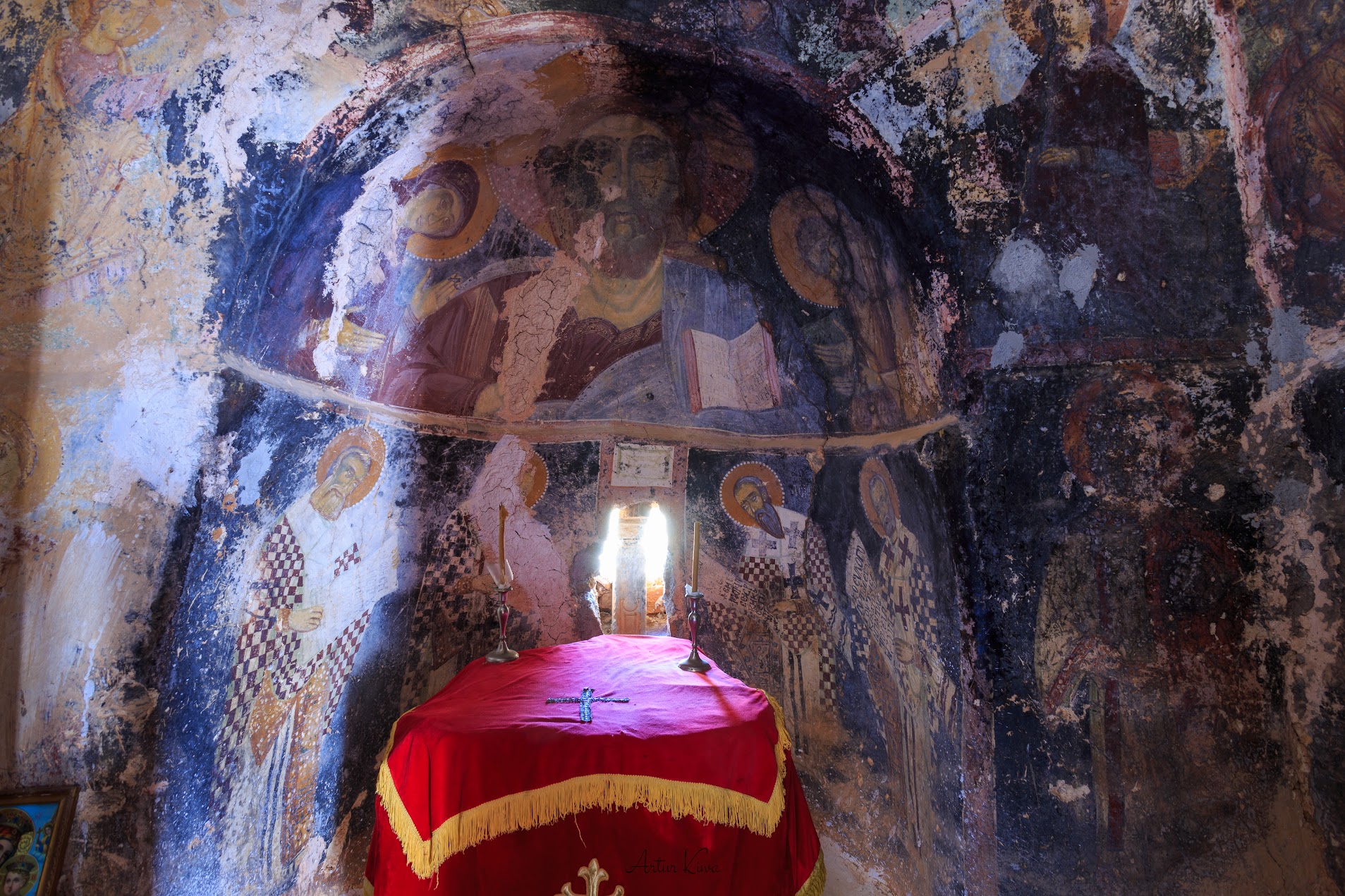
In the conch of the apse half-dome, a depiction of the Deesis has been placed: Christ Pantokrator accompanied by the Theotokos and Saint John the Baptist. Curiously, in a church dedicated to the Mother of God one would rather expect an image of the Platytera in this location. Lassithiotakis interprets this as an influence of Cappadocian monastic iconography. It is difficult, however, to state unequivocally whether this is the result of a specific external influence or rather a local interpretation or the freedom of a folk artist. Regardless of the cause, it is an unusual solution.
Next to the church stands a freestanding arcosolium. I was not able to determine who was buried there. As is often the case with churches in Sfakia, the arcosolium incorporates a fragment of an older architectural element set into its structure. It is possible that it comes from an earlier, perhaps early Christian, sacred building.
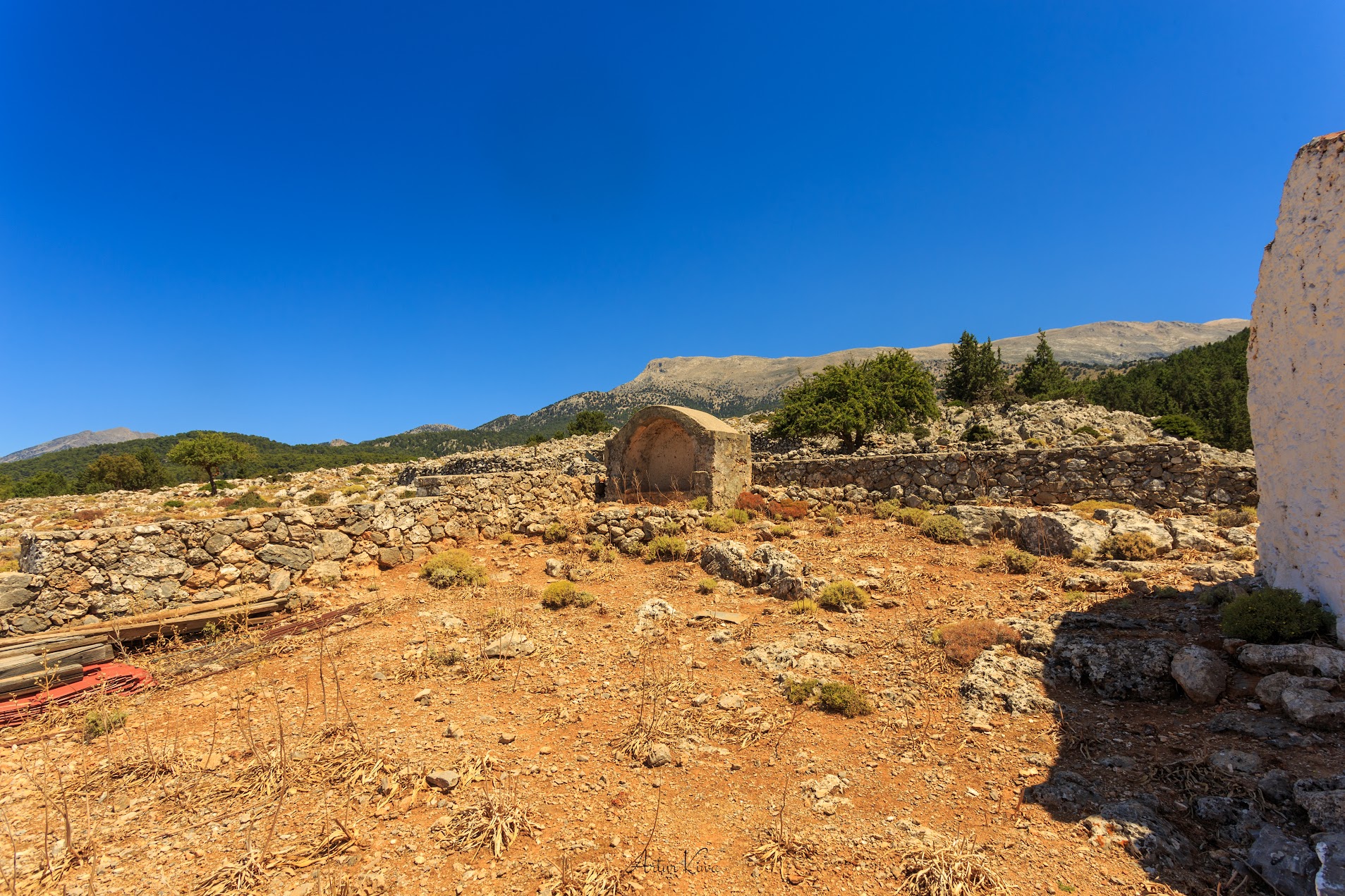
Such practices are often interpreted as a way of emphasizing the continuity of tradition and the sanctity of the place. There is also another, very interesting interpretation: embedding older elements was meant to highlight not so much religious continuity as the continuity of the community itself. The message was simple – the new faith changed nothing; we remain the same people. This hypothesis fits particularly well with the austere and strongly identity-driven character of Sfakia.
In short, this is a place worth every kilometer traveled to reach it. Exceptional in many respects and, quite simply, humanly beautiful and inspiring. True Sfakia – wild, simple, uncomplicated, with the bleating of sheep and the sound of bells in the background.
Editorial note. I know this church under the dedication Panagia. It is highly probable that its proper dedication is the “Dormition of the Theotokos”. Formally, this would be “Ιερός Ναός Κοιμήσεως της Θεοτόκου”, and colloquially “Παναγία Κοιμήσεως”, which likely explains the use of the name Panagia as a typical local shorthand. If I manage to confirm this conclusively, I will change the title. For now, Panagia remains.