Forgotten Heroines
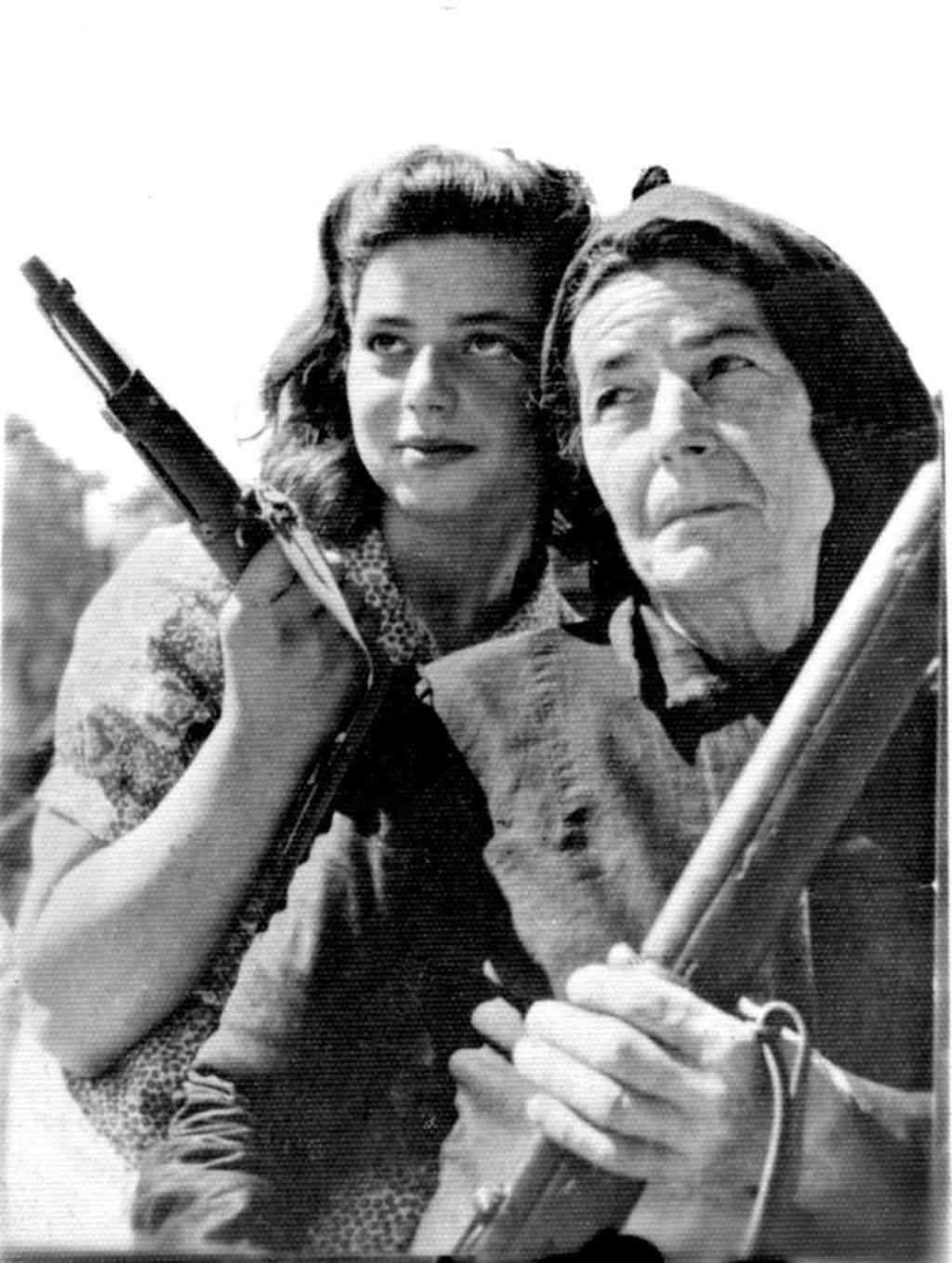
Women of the Cretan resistance during the Second World War.
Yesterday was International Women’s Day, and I had been carrying this text inside me for a long time — over a year, to be honest. Yesterday I didn’t feel like writing it, other things came up; today it finally does.
This will be about women, food, and how to shine even when you’ve run out of glitter. We’ll revisit old times none of us remembers, we’ll mention a few lesser-known and better-known figures.
The eighth of March is one of those days when people start listing famous women almost at random — usually the same few names, repeated like a mantra. The safe classics, the universally admired icons, and sometimes even people who have nothing to do with the subject at all, thrown in for effect. It’s a ritual of sorts. Today, though, we’re going to Crete, to meet someone far less known — but with far more courage than half the official pantheon put together.
We are going to Kandanos, in the western part of the island. A small, unassuming town — a church, a few tavernas, a square, a memorial. That’s about it. In the middle of all this stands the local place Mezostrato. I like it — they make good rabbit, and the atmosphere is great. I enjoy sitting there, watching the locals, stretching my bones a bit. Mezostrato appears in this story not only because of the food; it is the starting point of our tale about Cretan women, and it won’t be a story about kitchen work.
If, out of curiosity or physiological necessity, you enter the establishment across the street, on the left-hand wall you will see a portrait of two women. Black-and-white photographs like many others you’ll find in similar places. People hang portraits of family members, or their own younger selves. Anyone familiar with the Cretan interior won’t be surprised by this kind of décor.
But let us pause at this portrait, because it is the beginning and the key to our story about extraordinary women. A photograph like so many: two women, likely a generation apart — perhaps grandmother and granddaughter. The older woman holds a rifle, her face tired, gazing off to the side as if searching for something. Behind her stands a beautiful young girl, also armed, looking in the same direction. It’s hard to tell whether she is smiling; she looks slightly upward, not at the camera, as if caught in a moment of reflection. The image is strikingly contrasted: age and youth, black and white, gravity and lightness. You cannot walk past it indifferently.
The older woman is Antonia Vakaki, wife of Dimitrios. The younger — Eleni Vakaki, daughter of Georgios from the settlement of Trachiniakos. Both fought in the battle of the Kandanos gorge. Both experienced the brutality of the German occupiers. And both survived the war. The photograph was taken in July 1945 by Kostis Kotoulakis, who visited Kandanos together with Nikos Kazantzakis.
Eleni fought in the battle, witnessed the massacre in Kandanos, was captured by Italian soldiers and imprisoned in Naples. She was suspected — correctly, as it happens — of being involved in the resistance and of transmitting radio messages to British forces in the Middle East. Released after six months, she returned to Crete, where she was arrested again by the Germans. She was first imprisoned in Agia and later in Agios Nikolaos, subjected to torture, forced to witness executions, and eventually released by a military court in Chania. She lived to see the liberation of Crete while under house arrest. After the war she received a British medal — I was unable to determine which one, despite research in the UK national archives. Her later fate also remains unknown. This, however, can be fixed — her family runs Mezostrato.
Cretan women did not merely fight alongside men; they became radio operators, cared for Allied soldiers who remained on the island, supplied partisan units, and took risks every single day. During the German occupation, 1,113 women lost their lives.
Terpsychora Chrysoulaki-Vlachou from Sitia, a radio operator at the Toplou monastery. Arrested in June 1944, executed after a brief trial. She was 18.
Maria Glymidaki-Manolaraki from Chrysavgi in Kissamos. She helped her brother in an uneven fight against a German paratrooper, overpowering him with her bare hands. She was sentenced to death, but the sentence was commuted to life imprisonment. She was transported first to Auschwitz, then to Ravensbrück. She escaped shortly before the camp’s liberation and, after more than three months of walking, returned to Crete.
Eleni Marketaki, radio operator. Executed together with Terpsychora Chrysoulaki.
I cannot list all those who were killed, nor all those who stood up to the German occupiers with extraordinary courage. One day after the official holiday, I dedicate this small tribute to the unnamed and forgotten heroines.
I prepared for this text for several months. Most of the time went into searching for information about the later fate of Eleni Vakaki — unfortunately without success. I tried to keep the text as concise as possible; I tend to go on. I also ask for understanding regarding place names and surnames — transliteration from Greek to the Latin alphabet can be ambiguous. Forgive me if I distorted something.
And now, about that glitter. Now you know who is in the photo. So try this, if you ever make it to Kandanos: tell the owners you know who the women are — their expression is priceless. That’s how you shine.
And by the way: in Trachiniakos there are three beautiful old churches with frescoes by Pagomenos — I’ve written about them. There is no doubt that Eleni and Antonia knew those churches well — they likely prayed in them. And so the circle closes; everything is connected in one way or another.