Hell in Deliana. A Cretan lesson in fire
The Church of Saint John the Baptist in Deliana as a key to the mentality of its age.
Crete has never been an easy island to tame. Everyone who tried to rule it, from Byzantium to Venice, eventually had to admit that the locals possess a natural tendency toward independence – so radical at times that for many occupying powers it became a constant source of headaches. A quick look at the chronicles is enough to reveal a landscape woven from uprisings, micro-revolts, acts of sabotage, and a quiet, stubborn resistance to any external authority.
Under Venetian rule these tensions took on a particular sharpness. The Republic of Saint Mark, famous for its administrative pragmatism, divided the island into four territoria, hoping to bring order to its social and economic life. On paper it sounded like a perfect plan: structure, control, authority. In practice, the archontes – the local nobility – moved between Venice and their own communities with the finesse of people who had known for centuries how to play several keyboards at once. And the rural population reacted not with complaints, but with action. In the countryside a constant atmosphere of negotiation grew, in which state law counted only insofar as the community found it convenient.
In such a world the image mattered more than the word. A fresco – permanent, visible, impossible to ignore – became an instrument of politics and morality at once. In a society with low levels of literacy the image worked instantly, directly. It needed no commentary or translation. It lodged itself in memory. That is why Cretan depictions of hell, especially from the Venetian period, carry this extraordinary mixture of brutality, realism, and cool normativity.
Deliana: an unassuming, yet merciless church
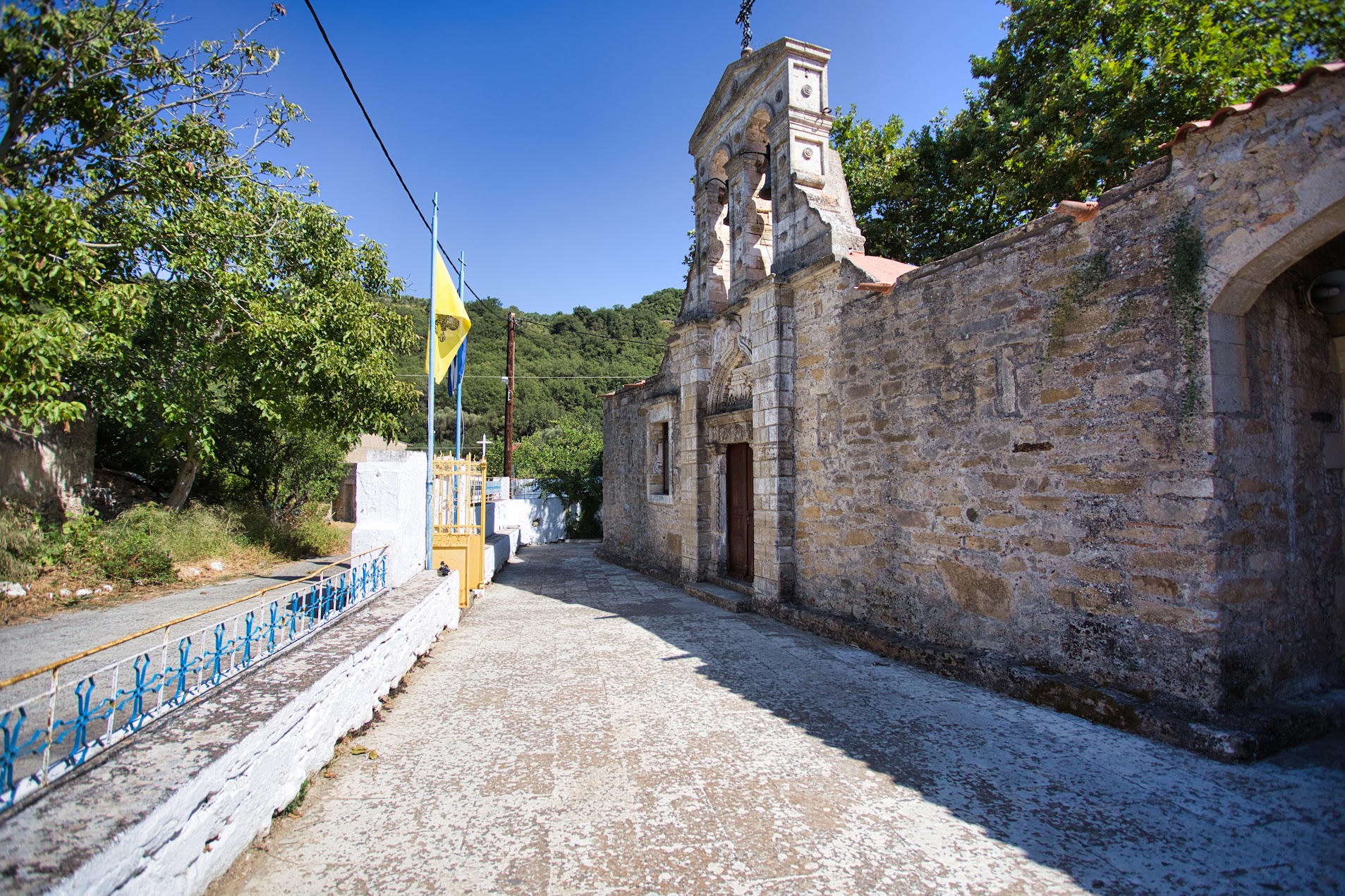
From the outside, the Church of Saint John the Baptist in Deliana looks like so many others: a simple single-nave building, slightly elongated, without decoration, without monumental ambitions. Nothing suggests that inside it holds one of the most intense visual moral lessons medieval Crete has left us.
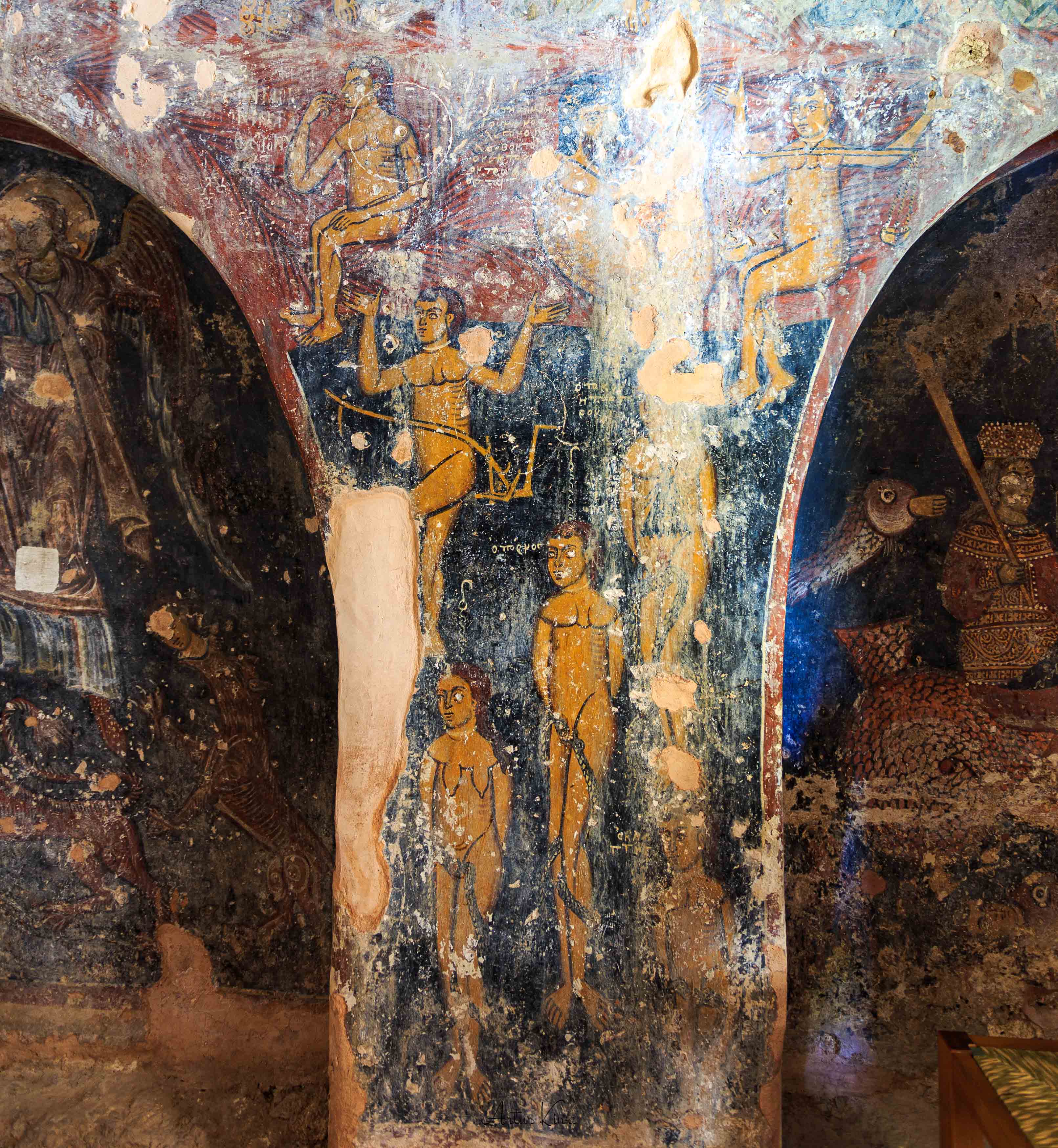
Only once later layers of whitewash were removed did it become clear that the southern wall, just above the entrance, preserves a full-scale scene of hell. No half-tones, no veils. What we see is not a chaotic jumble of figures, but an extended narrative spread across several levels. In the uppermost band we find the Place of Hell Formed by the River of Fire – a procession of the damned moving from left to right across the composition, set against a black background and red-hot, glowing ground.
The scene begins with a group of eight avenging angels. Their spears drive sinners into the flames, accompanied by a quotation from the Gospel of Matthew (25:41): ΠΟΡΕΒΕΘΣ ΑΠΕΜΟΥ ΟΙ ΚΑΤΗΡΑΜΕΝΟΙ Η͗ Σ ΤΟ ΠΗΡ ΤΟ ΕΌΝΙΟΝ – the call to “depart into the eternal fire”. At their feet kneel two figures in imperial dress, turned toward the angels as if in a final attempt to appeal to mercy. Further along we see a group of condemned clergy: clad in liturgical vestments stripped of all insignia, which in iconography signifies betrayal of Christ and of the Church.
Behind them comes a subgroup marked by the inscription ΟΙ ΑΡΕΙΑΝΉ – “the Arians”. Among them stands a naked man with a forked white beard, tearing at it in despair: Arius, the archetypal heretic. Beside him are his followers, one of whom covers his master’s genitals with his hand. Another naked figure – difficult to identify precisely – likely represents one of the other great heresiarchs, Sabellius or Macedonius.
The procession moves on toward three Western clerics with shaved faces and tonsures. Scholarly literature tends to label them Franciscans, although their habit does not match historical reality: two-toned, without the characteristic Franciscan cord, yet with elements resembling Orthodox epimanikia. Even so, the pointed hoods preserve a recognizable trace of Western influence, suggesting that the painter remembered their appearance only partially and filled in the gaps with details drawn from his own tradition.
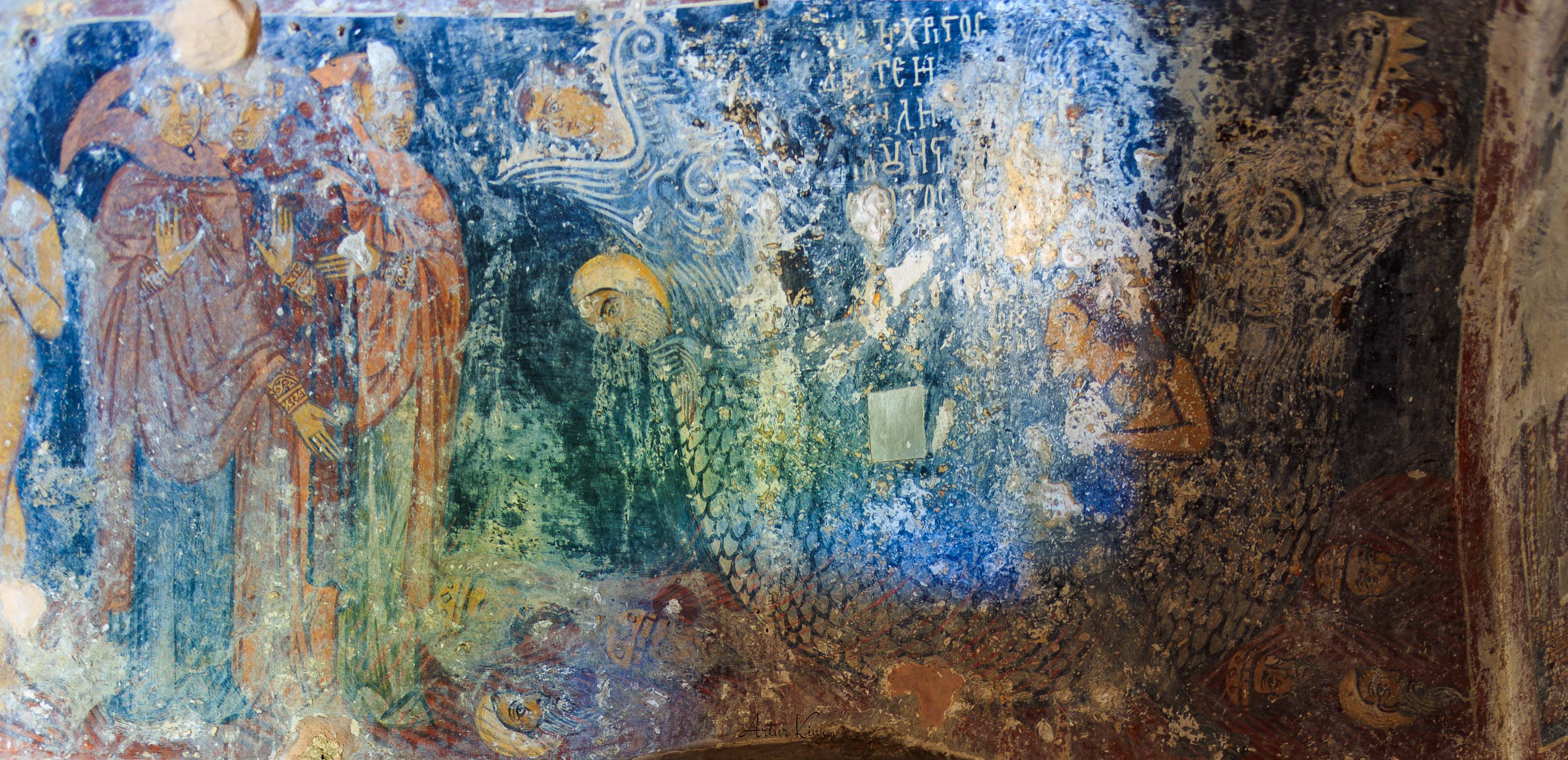
The entire scene culminates in a shocking climax: the figure of Satan, identified as “Antichrist calling my people”, holding Judas in his arms. He sits astride the Dragon of the Deep, blackened and scaly, with two heads turned symmetrically left and right, each devouring yet another damned soul. Around the dragon’s throne float severed heads in a sea of fire – bodiless witnesses to the ultimate penalty.
Below, beneath the great procession of the damned, the narrative suddenly changes scale. From the general fate of humanity we drop abruptly to the level of the individual. Here hell is no longer anonymous. Here the reckoning becomes intensely personal. In this register the painter no longer speaks of heretics, emperors, and clergy; he speaks of people whose sins could just as easily be recognized in one’s own village. And that is precisely why this part of the fresco hits hardest: it does not threaten with abstraction, but with concrete realities.
What strikes us most is the way punishment is tied to the body. The blasphemer has a serpent forced into his mouth. A woman who neglected her child suffers a punishment aimed at her breast – the place from which life flows. The adulteress is tormented exactly where her transgression disturbed the moral balance of the community. These gestures are so direct that even a modern viewer cannot escape their physical impact.
And yet none of these motifs is as powerful as the figure of the farmer who violates the boundary of a field. ΠΑΡΑΘΕΡΙΣΤΗΣ. The man who reaps beyond his own border. A rare motif, but in the context of Cretan village life painfully obvious. Conflicts over land, the shifting of boundary stones, dishonest harvesting or ploughing were among the most serious local disputes. The field boundary here carried a moral weight greater than any abstract doctrine. The fresco leaves no doubt: to cross it was to damage the very foundations of the community. Hence the brutal consistency of the punishment – the tool of work becomes the tool of torment.
Where does such meticulousness come from? The fire of the apocrypha
Such precision does not come from canonical texts. Cretan painters had access to a rich tradition of apocryphal and homiletic literature: the Apocalypse of Peter, the Visio Pauli, and later eschatological compilations that offered a catalogue of sins and punishments far more detailed than anything found in the New Testament. These texts circulated not only among clergy, but also in popular paraphrases, sermons, and oral traditions. Their language was vivid, graphic, corporeal – ready to be translated into visual form.
Within this context the fresco became a pedagogical tool. Contemporary scholarship speaks of “visual catechesis” – a form of teaching that relied on images rather than words. On Crete this mechanism had double power: it instructed and it disciplined. It showed that norms could indeed be broken, but that the consequences would be immediately visible – if not in the world of the living, then in the fiery landscape beyond death.
How did the painters work, and why does Deliana look the way it does?
Cretan painters’ workshops were mobile. Artists moved from village to village carrying with them sets of patterns and iconographic schemes. They worked quickly, economically, in a technique that required careful planning and a steady hand. Their frescoes were not expressions of purely individual creativity – they were social tools that above all had to be legible.
In Deliana the choice of location for the hell scene is no accident. Above the entrance, exactly where the viewer’s gaze inevitably comes to rest. The scene is not meant for subtle contemplation. It is meant to strike at the very moment a person crosses the threshold. The instant in which a tension arises: to enter, accept instruction, subject oneself to the community – or to turn back.
What does this hell say to us?
Looking at the fresco in Deliana, we see much more than a medieval vision of eschatology. We see a mirror of an age. A document of mentality. A story about what truly held the community together: loyalty, honesty, control of anger, respect for boundaries – both physical and social. There is no abstraction in this Cretan hell. There is earth, body, work, and sin that never appears out of nowhere.
This is why the hell of Deliana is so striking. It is not a theological concept. It is not a metaphysical landscape. It is an echo of life. A cruelty that only makes sense when we stop looking at the fresco as an image and begin to treat it as a form of local law.
And the modern viewer – even one standing there six centuries later – understands that this severity is not aimed at the human being. It is aimed at chaos. At disintegration. At those moments when the community ceases to function as a community.
And perhaps this is why Cretan hells are so honest. They do not tell us what we should fear after death. They tell us what people on this island were afraid of – and why that fear was sometimes necessary.
Sources and materials
- Hell in the Byzantine World (ed. Angeliki Lymberopoulou), description of the Church of Saint John the Baptist in Deliana
- Iconographic analyses of Cretan depictions of hell
- Research on apocryphal literature (Apocalypse of Peter, Visio Pauli)
- Catalogue studies of Cretan frescoes from the Venetian period