Chromonastiri - Panagia Kera
In Chromonastiri even silence has its own weight. This is not a village trying to win the attention of visitors — it is a place that lives by its own rhythm, as if time flows differently here.
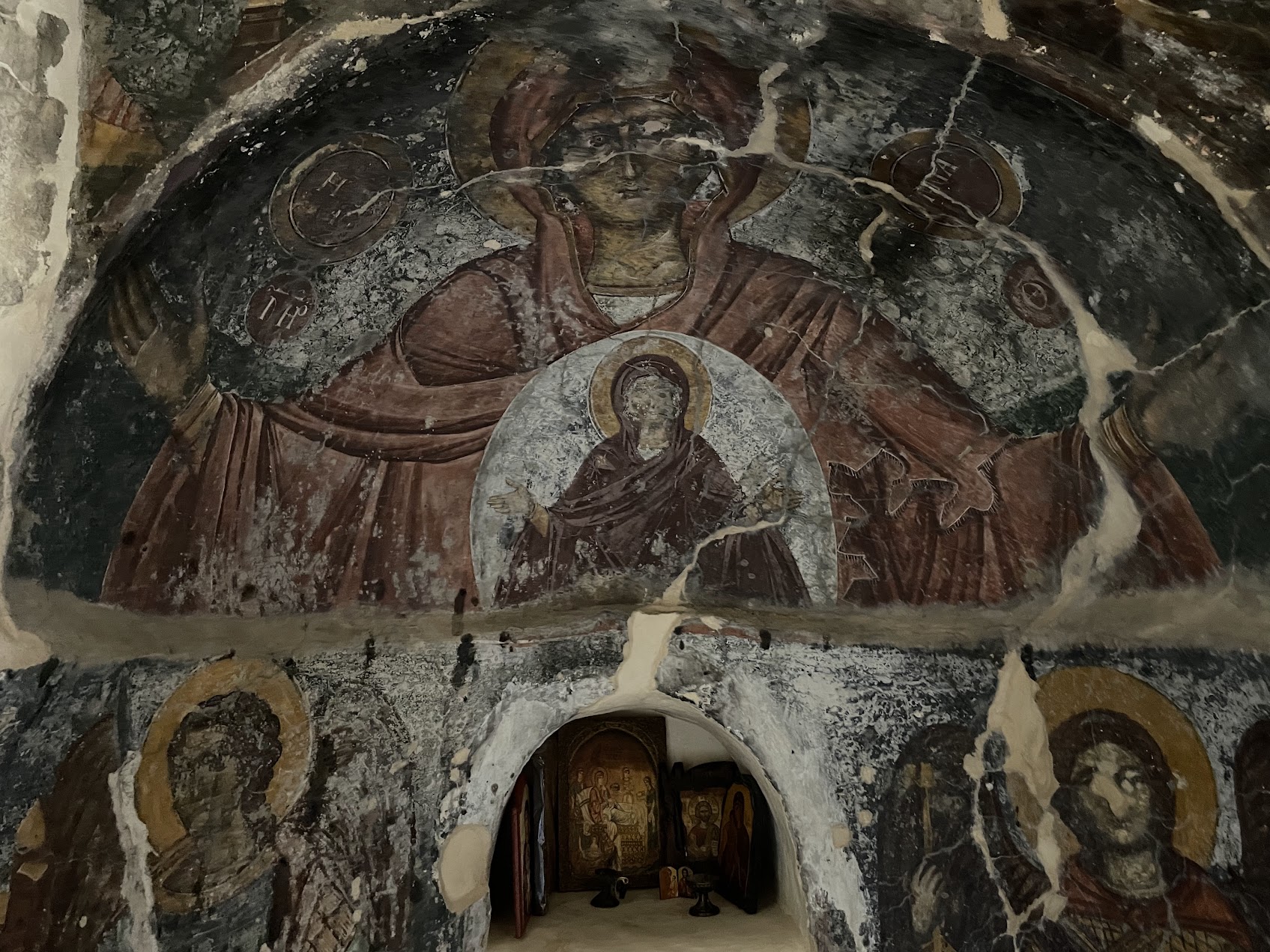
Panagia Kera in Chromonastiri is one of those churches that can stop you mid-stride, even if — like me — you have already seen hundreds of frescoes, apses, Platytéra depictions and entire iconographic programs. It sits modestly, almost woven into the fabric of the village, and yet it carries layers of history reaching deep into the era when Crete was still Byzantine, before the Venetians arrived and turned the island upside down with their own aesthetics and administration.
The church itself dates to the 11th century. That alone is impressive, because in this part of Crete relatively few early churches have survived, and even fewer preserve traces of the earliest wall paintings. Some fragments — isolated layers — may indeed belong to that period. But most of the visible frescoes today come from the 14th century, when the style we associate with late-Byzantine Crete and its “school” emerges fully: dynamic, synthetic, and deeply theological.
When I later returned to my photos, I edited them calmly, almost automatically, until I came upon the fresco in the apse dome. This is the most “privileged” place. The highest point in the iconographic hierarchy, the theological heart of the church. Here one normally finds either the Pantokrator or the Platytéra of the Heavens — the Virgin with her hands raised in prayer, with Christ Emmanuel in a medallion on her chest. This has been the canon for centuries. There is no room for improvisation. And yet…
At first glance everything appears correct: an upright female figure in a typical prayer posture, the upper body lifted toward heaven. Around her — preserved nomina sacra carefully arranged: ΜΡ ΘΥ with a clear titlo. Everything “says”: this is the Virgin.
Except something is wrong. Not a detail, not a nuance — nothing fits.
The first cracks appear when you try to verify the iconographic markers that work like signposts: the symbolic stars on Mary’s forehead and shoulders — signs of her virginity. Here they are missing. Not even a trace. And this is not decoration. It is essential. It is like a signature: without them, we do not have Mary. Meanwhile, in the medallion below — ironically — we see an unmistakably Marian figure, complete with stars.
Then it becomes even stranger: in the place of Christ Emmanuel — a woman. Covered hair, no cruciform halo (which belongs exclusively to Christ), none of the characteristic Christological elements. Instead of Emmanuel — another female figure. According to the inscription: also ΜΡ ΘΥ.
Either the painter made a spectacular iconographic error (unlikely given 14th-century Cretan discipline) or we are dealing with something far more deliberate. A shift in emphasis. A conscious intervention. A re-alignment of the theological space of the church.
Only the two additional medallions rising above the scene resolve the mystery. The left one — worn, with only the letter Η faintly visible. The right — more generous: when zoomed in, “ΑΝΝΑ” appears clearly. Then everything falls into place. Η ΑΓΙΑ ΑΝΝΑ. Saint Anna. Mary’s mother.
The central figure of the apse, in the place usually reserved for Christ or Mary, is… Saint Anna.
This is a solution that goes beyond the norm. And not only the Cretan one. In the theological topography of the church this place — the apse conch — is reserved for the highest iconographic hierarchy: Christ Pantokrator or the Virgin as Platytéra. Placing Anna here is so rare that public literature almost never mentions it. This particular church suffers further from being regularly confused with the far better-known Panagia Kera in Kritsa, so information about Chromonastiri often vanishes in the noise.
But here the iconography speaks for itself. The central figure is a woman without Marian markers. Mary is in the medallion below. Both bear nomina sacra. Above them — in the upper medallions — the inscription “ΑΝΝΑ” is clear. Therefore it is Anna who occupies the central position. Anna who takes the place normally given to her own Daughter or to Christ.
What does this mean? For now, we can only say it is an exceptional example of local devotion, likely reflecting a particularly strong regional veneration of Saint Anna. It might also be a remnant of some unknown local theological tradition or a family foundation in which Anna’s role was deliberately elevated. It may hint at changes in the iconographic program over the centuries — corrections, repainting, recontextualisations.
Regardless of the interpretation, this is a true rarity. Not just for Crete, but more broadly. And all of it hidden in a small, modest church a few kilometres from Rethymno, among olive trees — a place where no one would expect the iconography to overturn the canon so abruptly.
If you are nearby, step inside. It is a church that first captures you with its atmosphere and then reveals just how complex and unpredictable the history of Cretan sacred art can be.