Why in Crete it is easier to meet Saint George than an undented car
In Crete it is easier to come across an image of Saint George than an undented car. He is on the walls of village churches, along old routes, in places far from towns and their fortifications. He does not always fight a dragon; more often he simply is—alert, present, ready to intervene. This essay is not about a saint from a legend, but about a figure of protection in a world that, for centuries, lived in the shadow of very real threats: pirates, wars, abductions, and sudden death.
Before George becomes the hero of local stories and the patron of very real fears, it is worth pausing for a moment at his most classical image—the one that, for centuries, has been fixed in the icons of Byzantium and the post-Byzantine world. George on horseback, in armour, with a lance angled downward, piercing the dragon, is not an illustration of a specific historical episode, but a symbolic shorthand. An icon does not tell a story in the narrative sense. It puts the world in order.
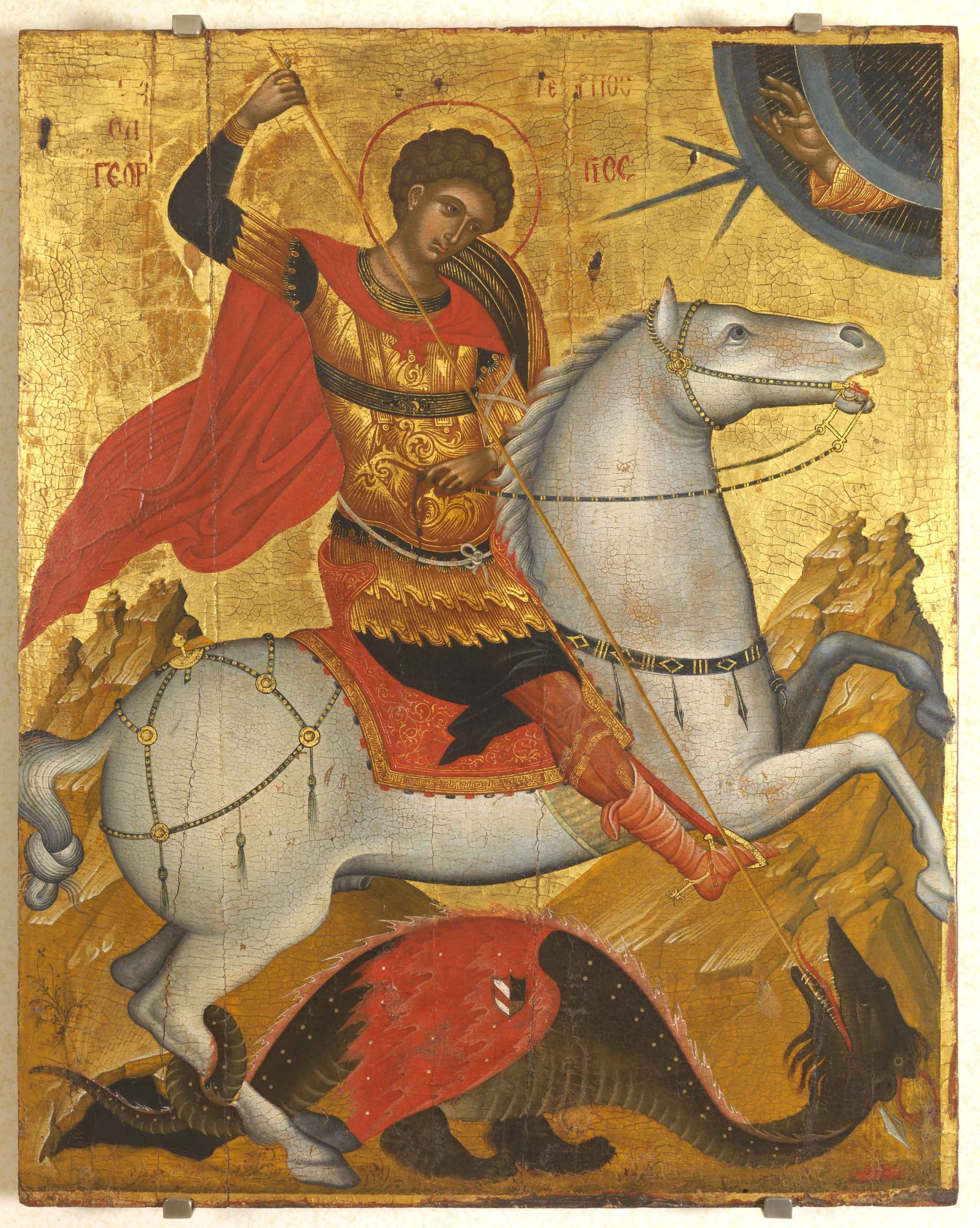
The horse, lifted above the ground, is not merely a war animal but a sign of movement and intervention—George arrives when order has been broken. The lance is not a weapon of aggression, but an instrument of restoring balance. The dragon, meanwhile, is not an exotic monster from a fairy tale, but a visual symbol of chaos: of what threatens a community, what comes suddenly and destroys without warning. In Christian iconography the dragon inherits meanings older than Christianity itself—from ancient personifications of evil, through the biblical “ancient serpent,” to apocalyptic images of danger that exceeds human scale.
That is why the classical icon of George is not primarily about combat as such. It is about the moment of intervention: the instant in which the saint places himself between the community and what overwhelms it. It is precisely this scheme—simple, readable, and at the same time remarkably capacious—that allowed the image of George to function across cultural and religious boundaries, retaining its meaning even where languages, rituals, and confessions changed.
So where did the entire dragon story actually come from? In the second half of the thirteenth century, a man named Jacobus de Voragine, an Italian Dominican and later Archbishop of Genoa, wrote a work with a telling title—the Golden Legend (Latin: Legenda aurea). It is there that the most influential and canonical version of George’s fight with the dragon takes shape. Near the city of Silene, the dragon is said to have made its lair and, through terror, forced the inhabitants to deliver people to be devoured. In the end it demanded a princess—sometimes present in iconography as a small female figure near the bottom of the image. The warrior saint killed the dragon and freed the city, and the grateful inhabitants embraced Christianity. That is the legend, in brief.
The story became extremely popular during the Crusades, when the cult of the warrior saint reached something like its apogee. Its symbolism is not only military: the slaying of the dragon and the rescue of the princess is often read as an allegory of liberating the Church from persecution.
The Cretan cult of Saint George reaches back to Byzantine times, when George held the status of a “court saint.” Over time he became a folk saint, a patron of farmers (γεωργικός—“agrarian,” “of farming”), and many popular beliefs and customs attached themselves to his name. A striking example is the annual blessing of sheep and milk in the village of Asi Gonia, performed on 23 April—a tradition that may well be older than the dragon legend itself.
Almost every church in Crete has its own George. Sometimes he is on horseback and drives his lance into the dragon’s mouth; sometimes he faces us frontally, motionless, with lance and shield, as if guarding the entrance. At times he is a youth, at times a mature soldier. Sometimes he is monumental; sometimes he barely fits into a fragment of wall. But he is there. Always there. And very quickly the question arises: why him?
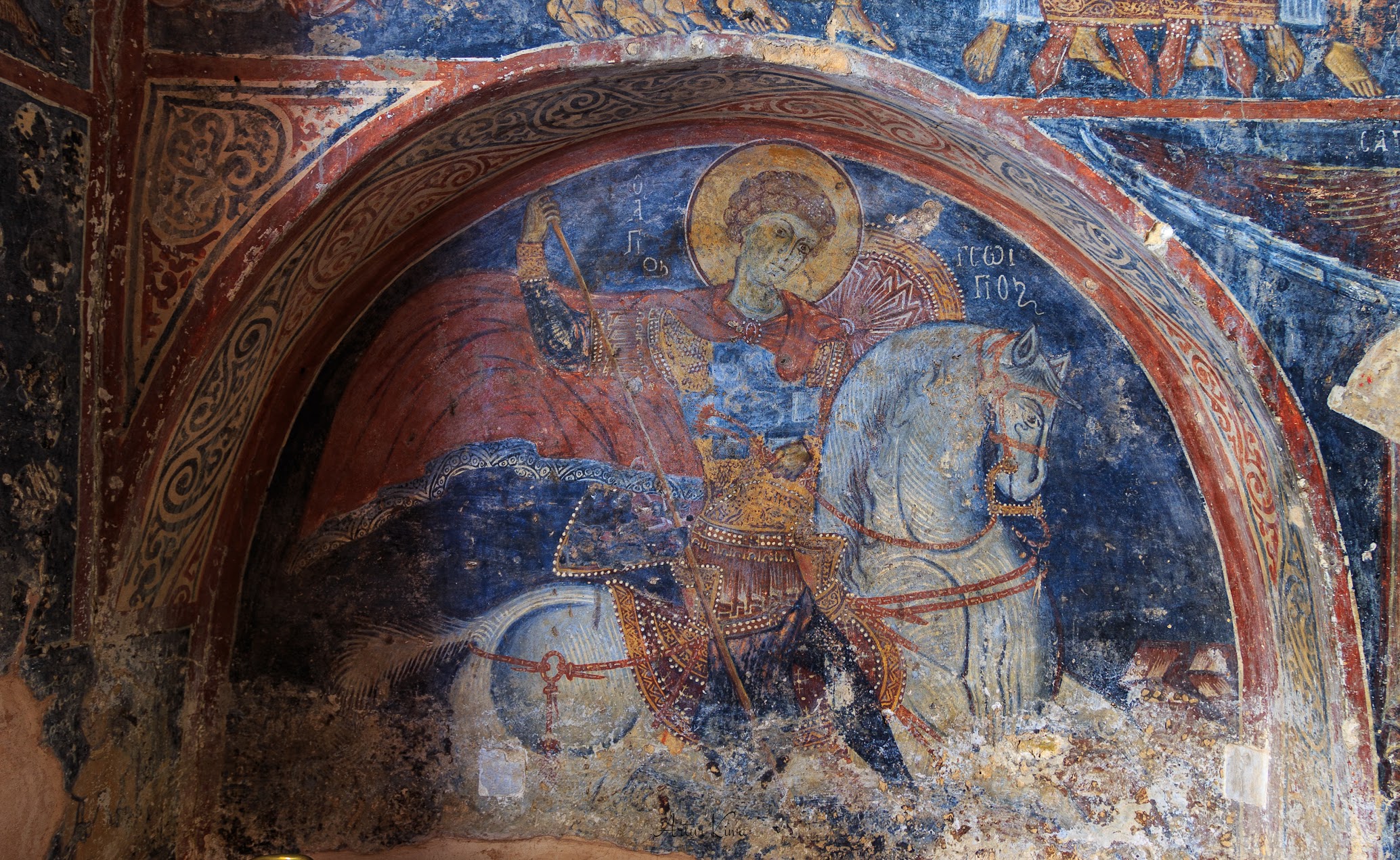
To understand this, we have to go far back—not to icons, but to the stories from which those icons grew. And to the world in which those stories were needed.
According to the earliest Lives, George was born in Cappadocia, on the eastern fringes of the Roman Empire, in a borderland where the military reality of the empire met local traditions and early Christianity. After his father’s death he moved with his mother to Lydda in Palestine—a place that very early became a centre of his cult. He was an officer in the Roman army, a man of hierarchy, orders, and violence. That detail, seemingly secondary, turns out to be crucial: from the beginning George functions as someone who knows the world of force, not only the world of prayer.
When persecutions of Christians began under Diocletian, George—according to hagiography—refused to offer sacrifice to the pagan gods. Later Lives describe a series of tortures he was made to endure: a spiked wheel, fire, poisons, a cauldron of boiling liquid. A historian must be cautious here. These images are products of theological imagination, not an execution report. But the meaning of the narrative is clear: George passes through what normally kills, and each time he emerges victorious. In the end he dies by beheading—and that is the one element that recurs across all versions of the tradition.
And yet in iconography that death is almost never visible. George is nearly always alive, active, in motion. Not because his martyrdom was unimportant, but because his role was not to die. It was to protect.
Here begins the real story of his extraordinary popularity.
In the eastern Mediterranean, George became a trans-cultural and trans-religious figure. Orthodox Greeks, Latins—Venetians, Franks, Catalans—and Muslims honoured him in parallel, often in the same sanctuaries, on the same days. In the Islamic world he was identified with al-Khiḍr, the mysterious “Green One,” a protector of travellers and of life, known from the Qur’an. Significantly, the day of his commemoration overlapped with the feast day of Saint George. This was not a conflict of symbols, but an overlay. Different religious languages described the same need: someone who stands on the side of the weak—something well demonstrated by research on the cult of Saint George under Latin rule in the eastern Mediterranean.¹
George was not a saint of doctrine. He was a saint of function. And that function had a very concrete meaning: defence against sudden evil.
In the Lives and miracles of George a motif returns again and again: protection of the helpless. The most moving is the story of the miraculous liberation of an abducted youth: George appears on horseback, takes the boy from captivity, and in an instant carries him home. In some versions the youth returns with a jug in his hand, as if the miracle happened in the middle of ordinary life. This is not heroic combat. It is an image of the world restored to order—of a child given back to his parents, of the weak delivered from the strong.
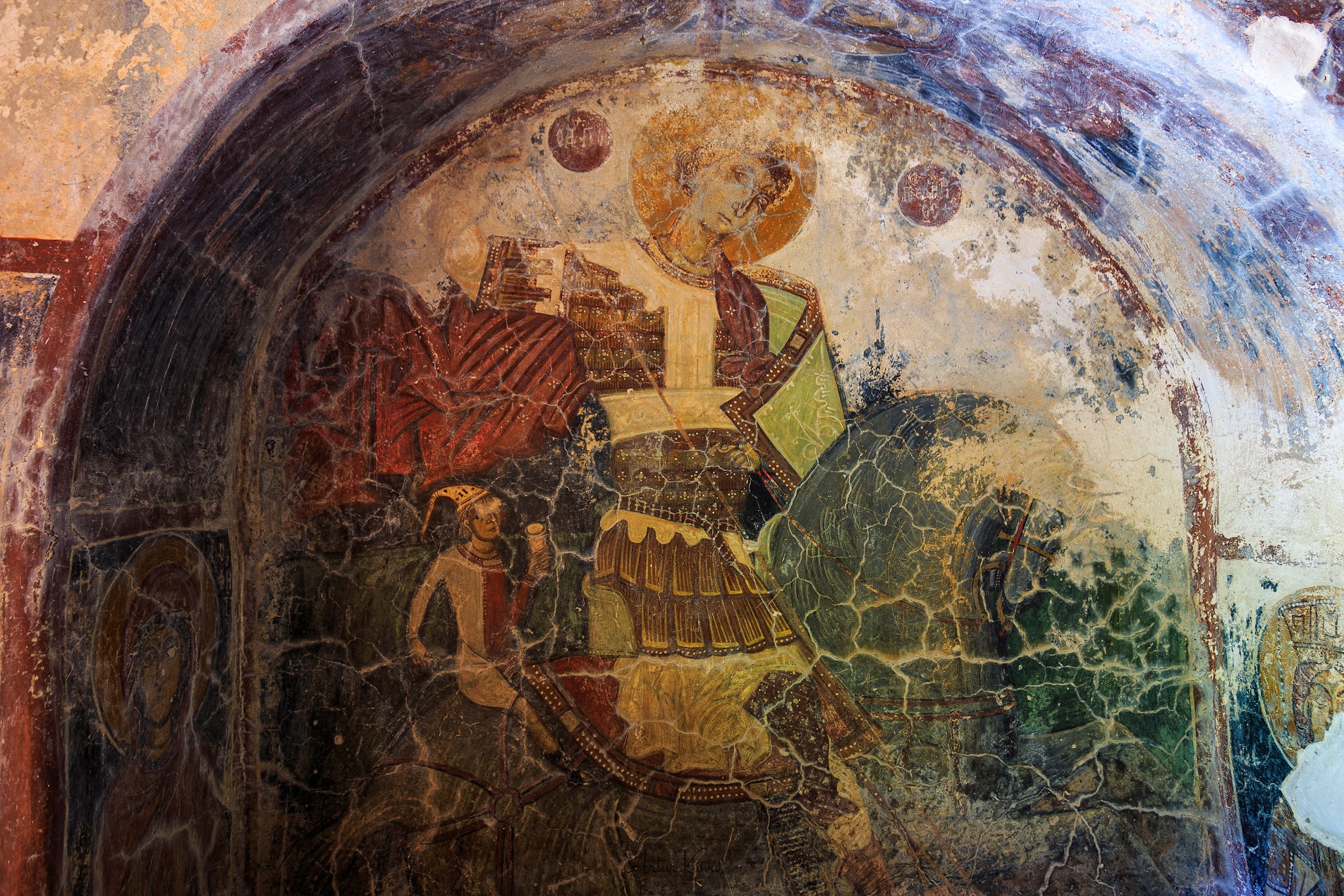
In icons this motif is often shown without drama: George rides, the boy sits behind him—no violence, no scream. That calm says more than a battle scene. And it is no accident that precisely such images appear in regions exposed to abductions and slavery.
Crete was one of those places.
An island living at the intersection of routes, exposed to pirate attacks, sudden raids, violence that could neither be predicted nor stopped. In such conditions George becomes a patron in the most literal sense. Not an abstract saint from a calendar, but someone who—people believed—intervenes here and now. That is why in local stories he so often appears as the one who protected a village from напад, who drove off attackers, who stood between a community and a threat.
The legend from Komitades fits squarely into this broader current. The story of prayer to Saint George and salvation from an attack is neither an exception nor a local fantasy. It is a variant of a narrative known across the region: the saint-as-defender. Such stories recur from Syria to the Balkans. Their function is always the same: to give meaning to experiences of fear and survival.
In source texts George is sometimes called “megas stratiotes”—a “great soldier.” The phrase does not refer to rank, but to role: someone who fights for the community. In one of the liturgical hymns we hear a plea that the “armed martyr” shelter the faithful from visible and invisible enemies. It is language perfectly suited to a world in which the boundary between the real and the supernatural was fluid.
That is why George settled so well into popular imagination. No theology was needed to understand him. Experience of danger was enough. It was enough to know that the state was far away, and help would not arrive in time. In such a world a saint who rides, fights, protects, and returns the abducted was someone real.
This also explains his ubiquity in the Cretan landscape. Churches of Saint George appear in remote places, along former tracks, in the mountains, near caves. His images are sometimes funded by the collective effort of an entire village, as if they were meant to work as a protective sign—an apotropaion—written into space itself. George stands, looks, keeps watch. Sometimes it is enough that he is there.
The dragon, which in the Western imagination has come to dominate the story of George, is only one of many shorthand expressions of that function. In Crete one encounters George without a dragon just as often as with one. And that, too, is no accident. The dragon symbolizes chaos in general, whereas a pirate, an attacker, or a violent death were very concrete realities. In folk stories George does not fight a myth. He fights what comes at night.
And perhaps that is why, when you hike across the island today, it is easier to find his image than an undented car. These images are not a relic of some bygone piety. They are a record of long memory—of a world in which safety was never obvious, and hope had to have a face, a horse, and a lance.
Before we start analysing icons and their variants, it is worth remembering one thing: Saint George in Crete is not an optional addition to church decoration. He is an answer to a very concrete experience of living on a frontier—between land and sea, East and West, fear and hope. And perhaps that is exactly why he still works.
¹ Manuel Castiñeiras, Crossing Cultural Boundaries: Saint George in the Eastern Mediterranean under the Latinokratia (13th–14th Centuries) and His Mythification in the Crown of Aragon, Arts 9, no. 3 (2020): art. 95,
https://doi.org/10.3390/arts9030095