Maza, Church of Saint Nicholas
Small, beautiful, and wrapped in local legend.
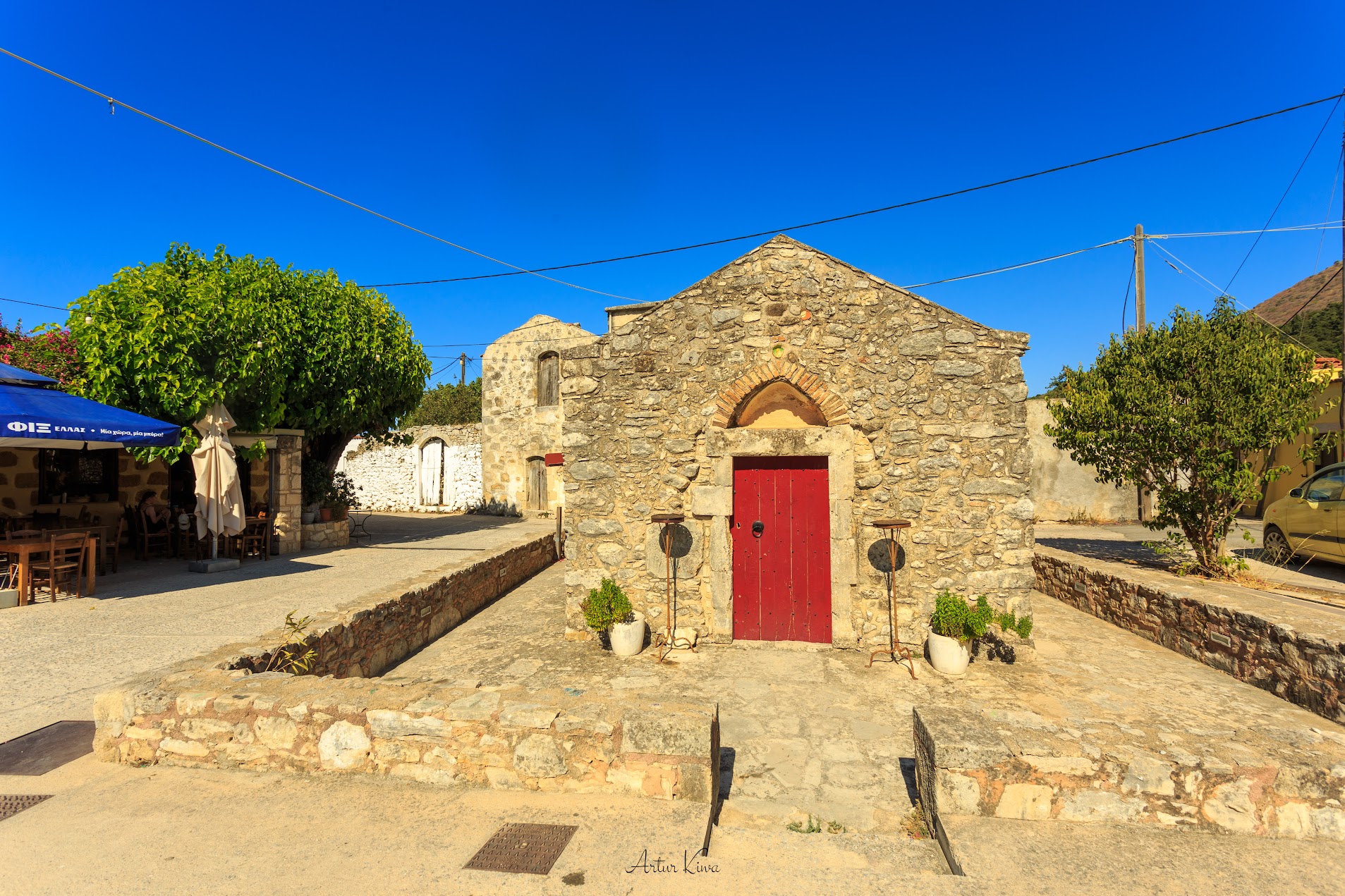
The village of Maza lies about forty minutes by car from Chania. A small, atmospheric place. One kafeneion, a few villas for visitors who are happy without access to the sea. Nothing more. In the very center: that kafeneion, a souvenir shop, and the church.
A tiny church, really, like most buildings of its kind from that period. But do not let the size fool you — you are standing before one of the most important Cretan monuments of the Venetian era: the Church of Saint Nicholas in Maza. If you ever need the local form, it is written as: Ναός Αγίου Νικολάου στη Μάζα.
From the outside modest and unassuming, nothing suggests what you will find inside. A typical structure: single-nave, barrel-vaulted, with a simple pitched roof covered in tiles.
The frescoes are in reasonably good condition; one can see the work of conservators, yet time has undeniably left its mark. The colors are faint and the surfaces heavily darkened by soot — the result of candles burned by the faithful over hundreds of years. Even today, in the small and confined interior, the candles continue to contribute to the slow erosion of the paintings.
The church in Maza is one of the best documented and most securely attributed works of Ioannis Pagomenos. On the west wall we have a clear dedicatory inscription bearing the master’s own signature: “…διὰ χειρός ἁμαρτωλοῦ Ἰω(άννου) τοῦ Παγομένου· ἔτους 6834” — “By the hand of the sinful Ioannis Pagomenos, in the year 6834 (1325/26).”
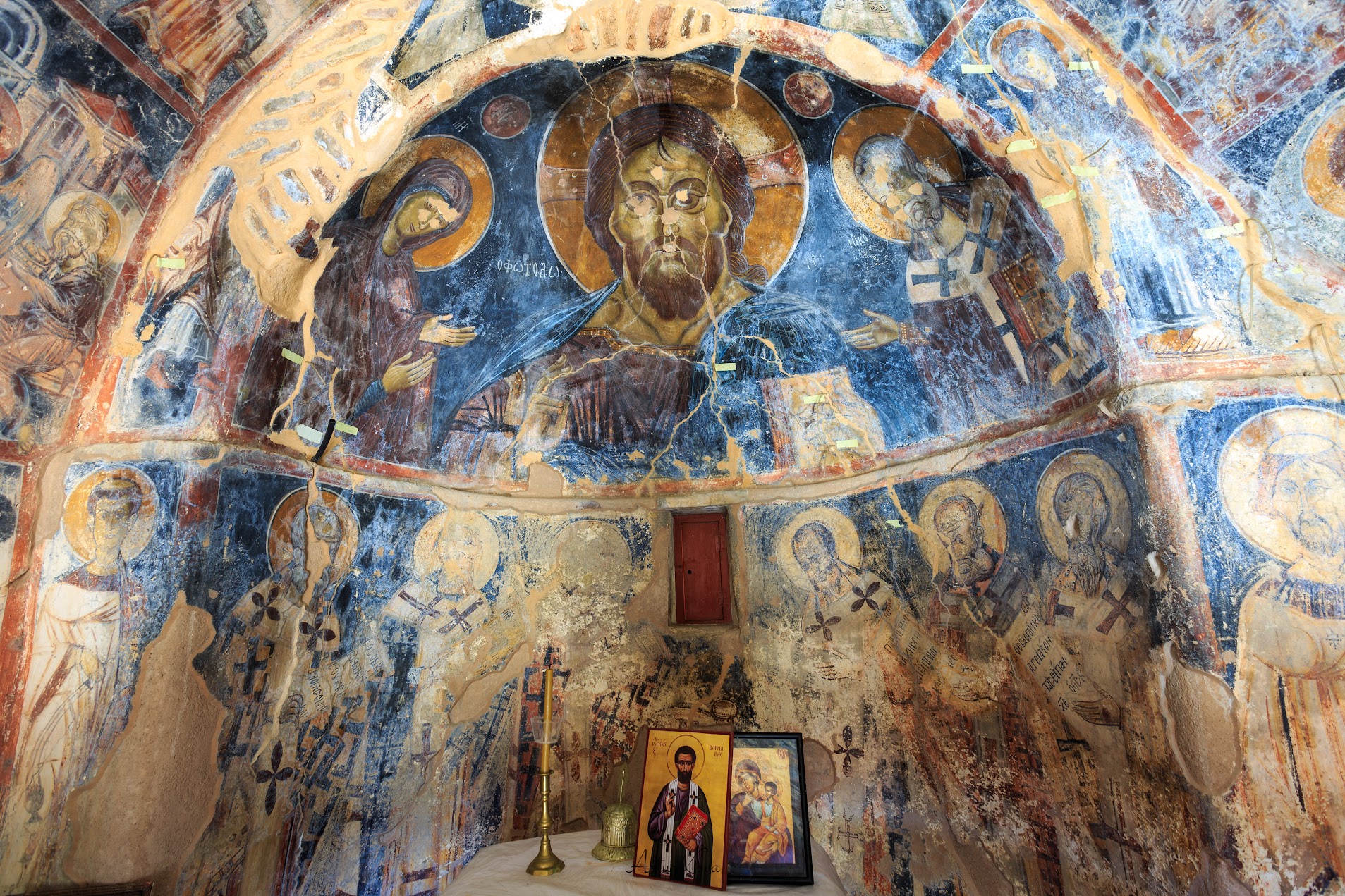
The iconographic program includes scenes from the life of Christ and probably several episodes from the life of Saint Nicholas. The apse is especially striking: decorated with the image of “Christ the Bringer of Light” (Ιησούς Φωτοδότης). This is not the classical Pantokrator with book and blessing gesture. It is a clearly signed image with the large, expressive eyes typical of the period and a strong use of light and shadow emphasizing Christ as the giver of light. Few similar depictions have survived, and this is one of the best preserved examples on Crete. To Christ’s right stands the Mother of God; to His left, Saint Nicholas — a notable deviation from the traditional Deesis, where John the Baptist usually appears. A deliberate substitution of John for the patron of the church.
The frescoes of Maza are likely the last known work of Pagomenos. No later pieces have been identified, giving rise to speculation that the painter may have died after completing this commission. Local legend claims he was buried beneath the church floor. These stories cannot be confirmed from scholarly sources. Historians and archaeologists note that a burial of an unidentified man was indeed found under the floor, but there is no way to establish his identity. The tale must therefore remain a legend — although a beautiful one. The idea of the master lying beneath his final work has a certain power.
The site is easily accessible, and the church is open. The key, if needed, is kept at the kafeneion. The people are friendly and very talkative. You can sit down, rest for a moment, drink a frappé and chat with the owner — highly recommended, a very welcoming person. If you are nearby, stop by to visit Pagomenos and Nicholas; it is worth the detour.
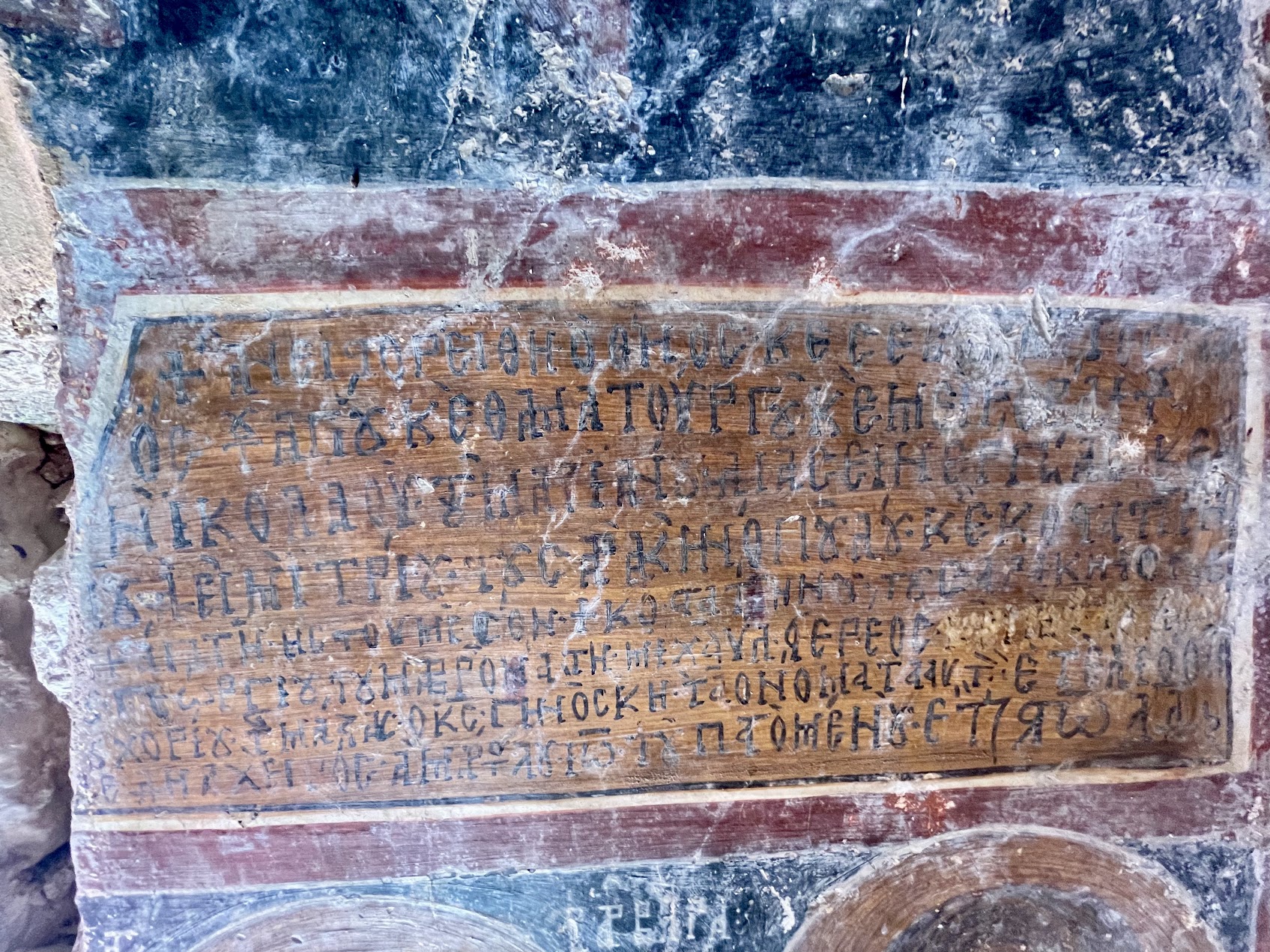
For the curious, the full inscription reads:
“Ανηστορείθη ο θήος κε σεβάσμειος ναός του Αγίου κε θαυματουργού κε μειροβλίτου Νικολάου του Μαζιανού δια σεινεργήας κε κόπου Δειμιτρίου του Σαρακηνοπούλου κε Κοστατήνου [του] Ράπτη ης του μισόν Κοστατήνου του Σαρακηνοπούλου του Γεωργίου του Μαβρομάτη Μιχαήλ ιερέος κε παντός του λαού του χορίου τ(ης) Μάζας. ο Κ(ύριο)ς γηνόσκη τα ονόματα αυτ(ών). Ετελιόθη δε δηα χειρός αμαρτολού Ιω(άννου) του Παγομένου. Έτ(ους) ςωλδ”
Translated:
“The divine and venerable church of Saint Nicholas the wonderworker and myroblyte of Maza was restored through the cooperation and labor of Dimitrios Sarakenopoulos and Konstantinos the Tailor (Raptis), half-brother of Konstantinos Sarakenopoulos, of Georgios Mavromatis, of the priest Michael, and of all the people of the village of Maza. The Lord knows their names. It was completed by the hand of the sinful Ioannis Pagomenos, in the year 6834.”
And one final curiosity: “Sarakenopoulos” is a surname formed from “son of a Saracen.” Whether this refers to an actual descendant of a Saracen or has some non-ethnic origin remains unknown.