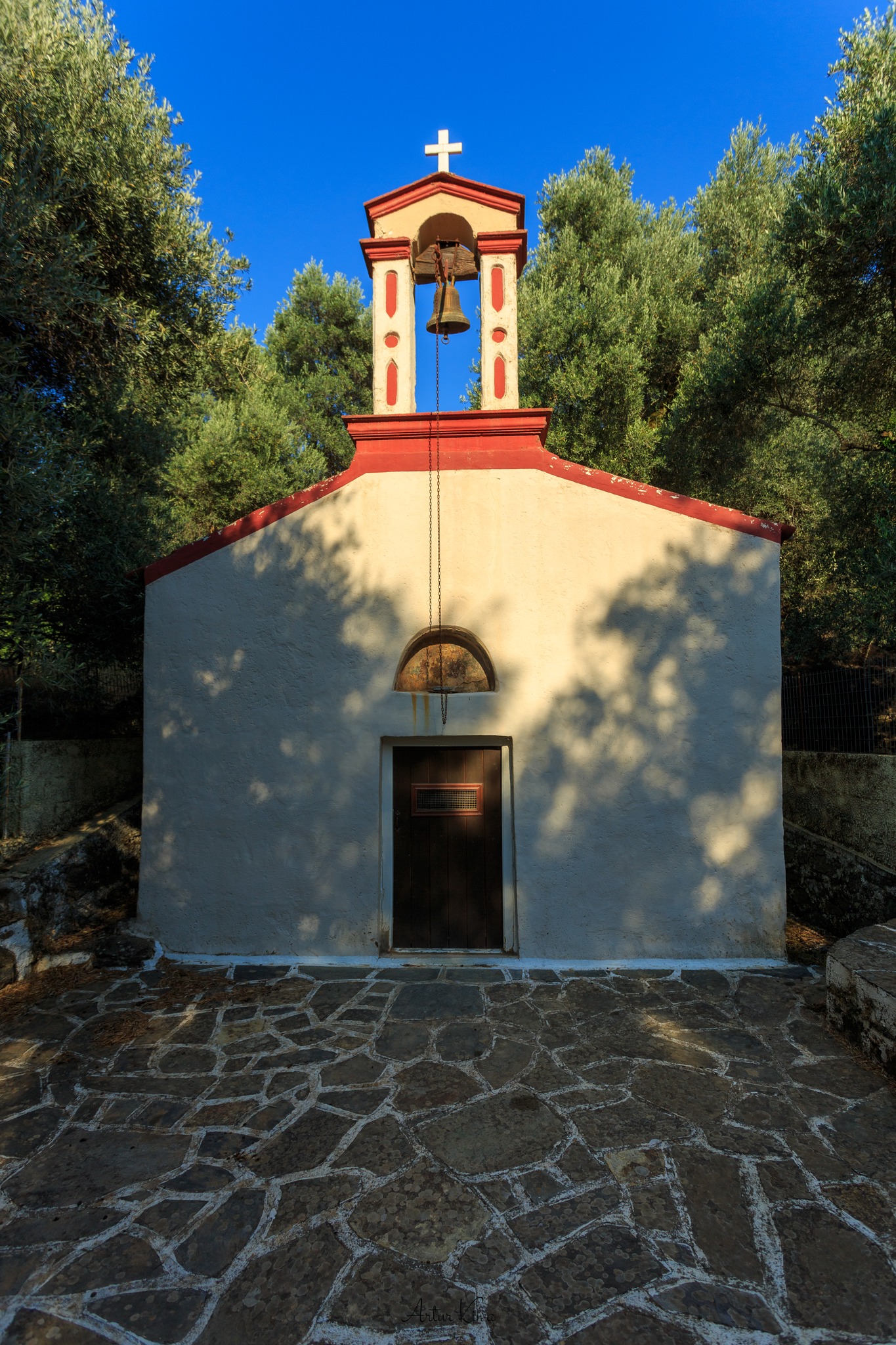
Anisaraki, Church of Saint Anna
One of the most iconographically striking churches in Selino.
When this church was being built, Europe was still breathing the dust of the Crusades. In England, Henry III, son of John Lackland, struggled to hold together a kingdom torn apart by the ambitions of its magnates, while in France Louis IX reigned, remembered by posterity as a saint. In Poland, Konrad of Masovia invited the Teutonic Knights to the Vistula, unaware that he was sowing the seeds of a powerful monastic state that would cast its shadow over the region for centuries. In Rus’, divided and weakened, catastrophe approached: the Mongol hordes of Batu Khan, soon to devastate Kyiv and plunge Eastern Europe into fear.
Across the ocean, the Maya and Aztecs built calendars, temples and rituals, unaware of Europe’s existence. In China, the Song dynasty perfected porcelain, printing and the compass, while in Persia Rumi composed mystical poetry that would remain alive eight centuries later. And here, on Crete – an island newly taken by the Venetians – a small stone church of Agia Anna was rising in the tiny settlement of Anisaraki, among fields and olive groves.
Frescoes and the Iconographic Program
Looking at its interior today, we see what a 13th-century believer must have felt with a mixture of fear and awe. In the apse dominates the image of the Virgin Mary as Orans, shown frontally with the Christ Child on her lap – the type Platytera ton Ouranon, “wider than the heavens.” Her raised hands symbolize intercession and at the same time separate the earthly realm from the heavenly one.
In the dome, the painter placed the Pantokrator: Christ as ruler of the universe, holding a book and blessing the faithful. Around Him stand angels, prophets and evangelists, forming a cosmic hierarchy. This was not decoration; it was theology in images, a kind of Biblia pauperum for people who could not read.
The side-aisle walls illustrated the life of Christ: the Annunciation, Nativity, Baptism, Transfiguration on Mount Tabor. Each scene followed the canonical scheme, yet the local style is visible: elongated figures, austere faces, colors of red and ochre that withstood darkness well. The lower zones were adorned with warrior-saints – George, Demetrius, Theodore – armored knights believed to protect against disease, raids and evil spirits.
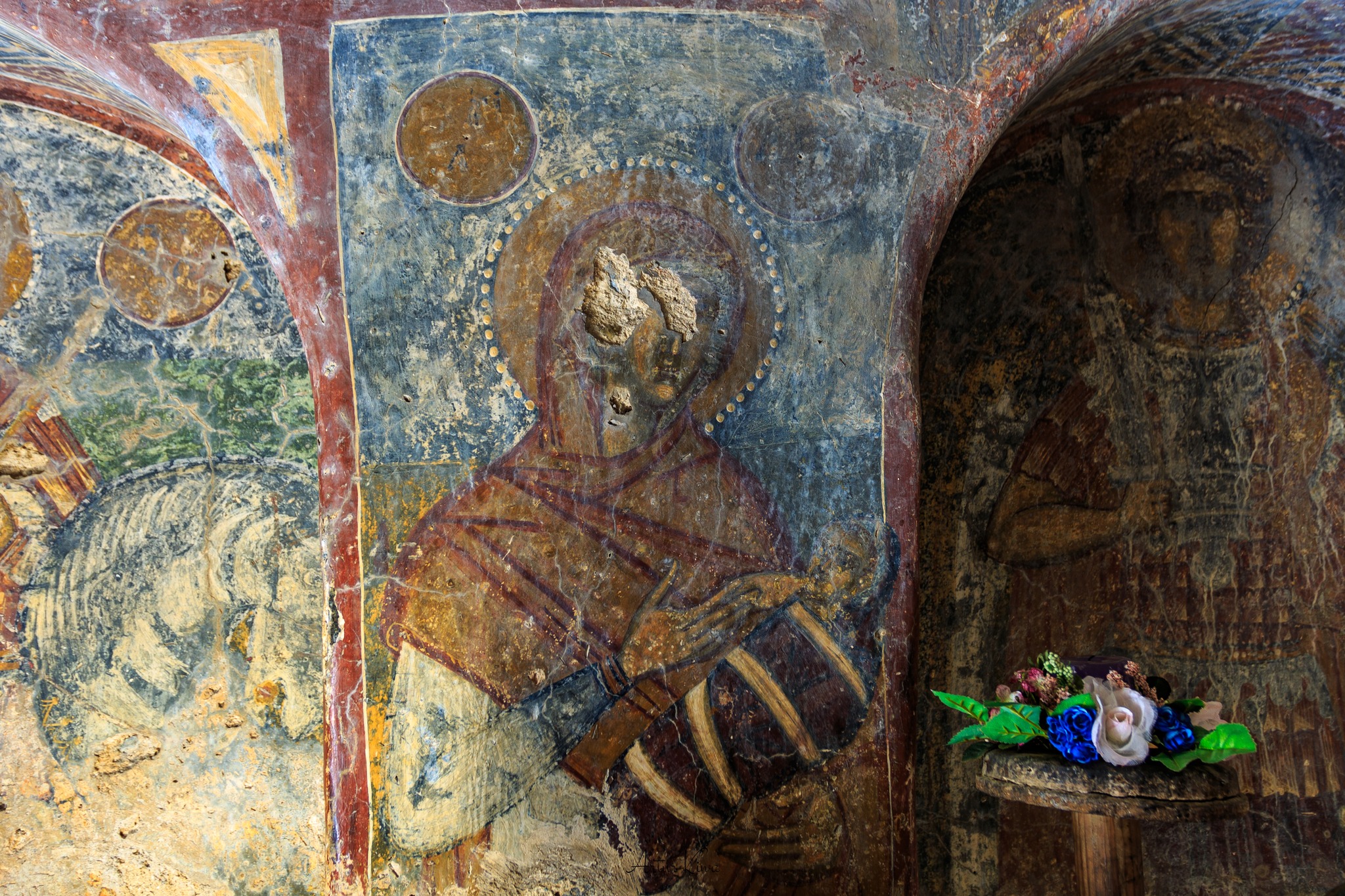
Yet Anisaraki holds something more — a fresco that makes this church exceptional even within the broad landscape of the Byzantine world. Here we encounter a depiction of Saint Anna nursing her daughter, the Mother of God. This motif is known from only a handful of examples of the Anna Galaktotrophousa type. As demonstrated by Hirofumi Sugawara, across the entire Byzantine world only a few secure realizations of this theme can be identified, and almost exclusively in highly specific contexts. Against this background, the fresco from Anisaraki emerges as one of the very few surviving monumental representations of this iconography — intimate in expression, yet theologically dense, uniting the physicality of motherhood with the mystery of the Incarnation.
What fascinates researchers is the coherence and completeness of the iconographic program in such a small church. As Thetis Xanthaki notes, the frescoes of Agia Anna in Anisaraki represent the classical current of 13th-century Cretan painting: still strongly rooted in Byzantine tradition, yet already showing certain simplifications and stylizations that herald later Venetian-period tendencies.
Learning and the World
While in Anisaraki a painter mixed pigments with lime and egg yolk, the learned world still believed that the Earth was the center of the cosmos and that the human body was governed by Galen’s four humors. No one had dreamed of a telescope; the microscope would arrive four hundred years later. Gutenberg had not yet been born, so every book was copied by hand in monastic scriptoria. But what we now see as darkness was for them fullness: images, hymns, liturgy – an entire world of symbols that held the community together.
Endurance
Agia Anna stands to this day – a small stone church where silence carries the weight of centuries. Its frescoes, though faded, still echo voices from eight hundred years ago. When we look at them, we should remember that at the time of their creation Columbus would not sail west for another two and a half centuries, Copernicus had not yet been born, and Galileo would enter the world only when these frescoes were already long covered in patina.
And yet the church endures. As if saying: life passes, powers fall, Crusades fade, empires rise and crumble – but the trace of the person who raised the stones and painted the saints may last forever.
We are – if not the last, then among the last generations able to see these frescoes in person, in the dim light of small churches. The lime cracks, colors fade, walls slip into silence, and time is merciless. What was everyday life for the people of the 13th century is for us almost a miracle – fragile and impermanent. Each visit to such a church is an encounter with a past that is dying before our eyes.
These are not just stones and paintings. They are witnesses of history that remain silent even though they have seen everything: Crusaders, Venetians, Ottomans, wars, uprisings, and finally modern indifference. Every flake of fallen plaster, every forgotten chapel is a loss that can never be undone.
And this is why, standing before Agia Anna in Anisaraki today, one must realize that we are looking at something unique, unrepeatable. Something dissolving in time like a dream – and yet for a brief moment, we can take part in it. Perhaps that is why it was given to us: so that we might see and remember before it disappears forever.